

Showing posts with label 3. Sunday after Pasha. Show all posts
Showing posts with label 3. Sunday after Pasha. Show all posts
Sermon on the Myrrhbearing Women
 St. Gregory Palamas
The resurrection of the Lord is the regeneration of human nature. It is the resuscitation and re-creation of the first Adam, whom sin led to death, and who because of death, again was made to retrace his steps on the earth from which he was made. The resurrection is the return to immortal life. Whereas no one saw that first man when he was created and given life—because no man existed yet at that time—woman was the first person to see him after he had received the breath of life by divine inbreathing.

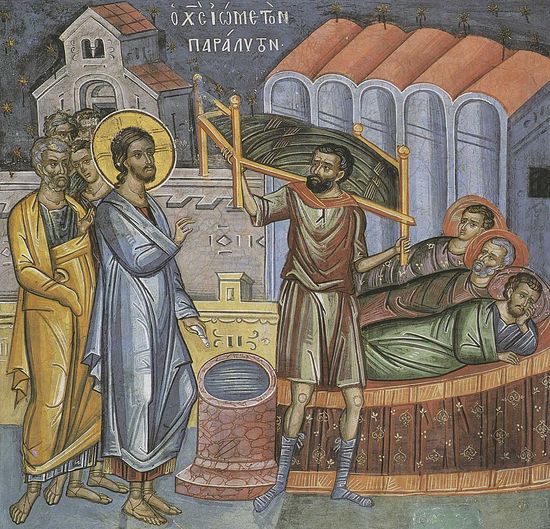
Sunday of the Paralytic
 Archpriest Andrew Phillips
In the Name of the Father and of the Son and of the Holy Spirit.
Today's Gospel of the healing of the paralytic raises a number of questions.
The first perhaps is:
Where does illness come from?
The answer to this question is contained within the selfsame Gospel, in the words of Our Lord to the healed paralytic: 'Sin no more lest a worse thing come unto thee'. In other words, the origin of illness is in sin.

Metropolitan Anthony of Sourozh -
SUNDAY OF THE PARALYTIC
In the Name of the Father, the Son and the Holy Ghost.
How tragic today's story of the life of Christ is. A man had been paralysed for years. He had lain at a short distance from healing, but he himself had no strength to merge into the waters of ablution. And no one - no one in the course of all these years - had had compassion on him.
The ones rushed to be the first in order to be healed. Others who were attached to them by love, by friendship, helped them to be healed. But no one cast a glance at this man, who for years had longed for healing and was not in himself able to find strength to become whole.

Synaxarion For the Sunday of the Paralytic
By Nikephoros Kallistos Xanthopoulos
SUNDAY of THE PARALYTIC
On this day, the fourth Sunday of Pascha, we commemorate the Paralytic and, as is meet, we celebrate the miracle wrought for him.
Verses
The word of Christ was strength for the Paralytic,And thus this word alone was his healing.

The Paralytic and the Paralysis of Egoism
By Fr. Alexander Schmemann
On the third Sunday after Easter, the reading from the gospel of John recounts Christ’s healing of a paralytic. “There was a feast,” writes the Evangelist John, and Jesus went up to Jerusalem. Now there is in Jerusalem by the Sheep Gate a pool, in Hebrew called Bethsaida, which has five porticoes. In these lay a multitude of invalids, blind, lame, paralyzed waiting for the moving of the water; for an angel of the Lord went down at certain seasons into the pool, and troubled the water: whoever stepped in first after the troubling of the water was healed of whatever disease he had. One man was there, who had been ill for thirty-eight years. When Jesus saw him and knew that he had been lying there a long time, he said to him, “Do you want to be healed?” The sick man answered him, “Sir, I have no man to put me into the pool when the water is troubled, and while I am going another steps down before me.” Jesus said to him, “Rise, take up your pallet, and walk.” And at once the man was healed, and he took up his pallet and walked. (Jn 5:1-9)

The Paralytic's Endurance and the Meaning of Life
Homily For the Sunday of the Paralytic
By Metropolitan Augoustinos Kantiotis
"And a certain man was there, which had an infirmity thirty and eight years."(John 5:1-15)
The question is asked, beloved, what is life? Is it enjoyment? Is it amusement? Is it dancing and fun? Is it "let us eat and drink for tomorrow we die"? Many people think this way, especially the young of our times, who are carried away by materialistic and atheistic ideas and think that the few years they are going to live on this planet must be lived as happily and as hedonistically as possible. They have as a kind of motto the Italian phrase dolce vita, which means "sweet life". For them, sweet life means living day and night at various amusement centers, dancing wildly, singing obscene songs, engaging in loud behavior, and taking drugs to achieve a chemical paradise of pleasure for a few hours. Once those hours pass, these unfortunates fall into a terrible state of depression and gloom.

Homily for the Sunday of the Paralytic
Archimandrite Tikhon (Shevkunov)
Today is a feast day for all of us paralytics. Today, brothers and sisters, we to a certain degree are meeting our name-day, our feast day. Who among us can boast that he is strong, courageous, bearing all the misfortunes of this age, fulfilling all of Christ’s commandments? Deliver us, O Lord, if such a person stands in our midst — one cannot imagine a worse righteous or strong man! The Apostle Paul says: "Therefore I take pleasure in infirmities, in reproaches, in necessities, in persecutions, in distresses for Christ’s sake: for when I am weak, then am I strong" (2 Cor 12:10). But the Apostle did not deprive himself of one thing: strong faith and undoubting hope in the Savior. “The power of God is made perfect in weakness!”
Created for Eternal Life
St. Justin Popovic
The following sermon was delivered at the Ćelije convent in 1978 on the Sunday of the Paralytic, which coincided with the feast day of St. John the Theologian
Christ is Risen! Truly He is Risen!
In four words is expressed the entire mystery of this (and the other) world, of every person, of the mystery of my being, and of the mystery of your being. If there were no Risen Lord, His Resurrection would not be; and if there were no Risen Lord, we would not be – there would be no Christian in the world.
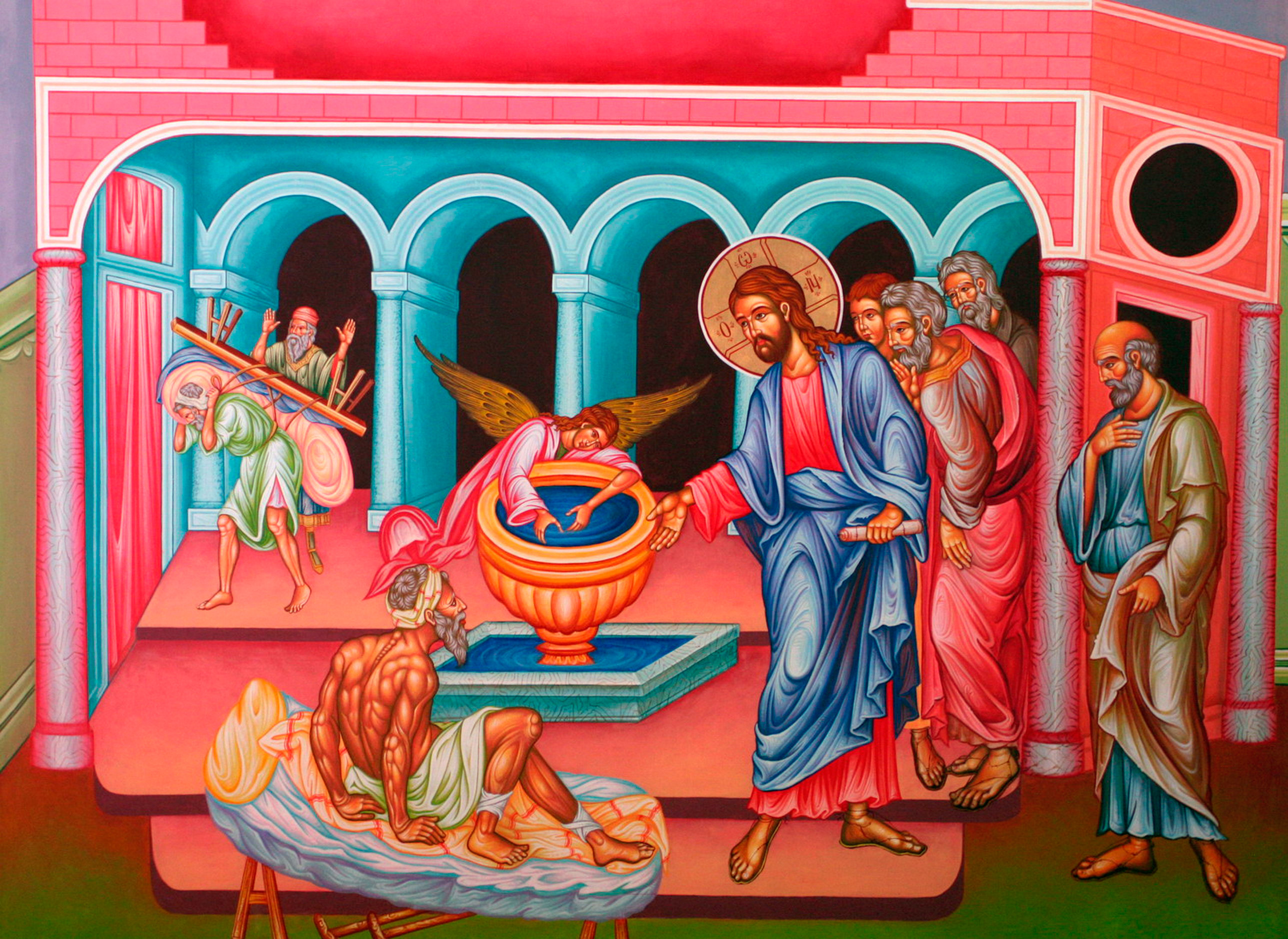
INSTRUCTION ON THE SUNDAY OF THE PARALYTIC
Christ is Risen!
The holy Evangelist John the Theologian tells us that in Jerusalem, by the Sheep’s gate is a pool, before which there were five closed entrances where a multitude of the sick lay. At times an Angel of the Lord would descend into the pool and trouble the waters, and whoever would first step into those waters would be healed (Jn. 5:2–4). Passing through towns and villages, revealing to people the mysteries of the Kingdom of God, Christ came one day to the Sheep’s pool. He saw there those sick people who desired healing. Among them was a man who suffered from an infirmity for thirty-eight years. Christ came to him and asked, "Do you want to be made whole?" (cf. Jn. 5:6). The sick man answered, "Sir, I have no man, when the water is troubled, to put me into the pool: but while I am coming, another steps down before me." Christ said to him, "Take up your bed and walk," and the sick man was immediately healed (cf. Jn. 5:7–9). After some time Jesus Christ met him in the temple and said, "See, you have been made healthy. Sin no more, lest a worse thing should come upon you" (cf. Jn. 5:14).

Fourth Sunday After Pascha:
Feast Of The Sunday Of The Paralytic
Introduction
The third Sunday after the Feast of Holy Pascha is observed by the Orthodox Church as the Sunday of the Paralytic. The day commemorates the miracle of Christ healing a man who had been paralyzed for thirty-eight years. The biblical story of the event is found in the Gospel of John 5:1-15.
Background
Icon of the Healing of the Paralytic, used with permission from Theologic
 St. John Chrysostom,
Homilies on the Gospel of John,
3. Saturday after Pasha,
John 15:17-16.2
These things
I command you, that you love one another.
That is, It
is not to upbraid, that I tell you that I lay down My life for you, or that I
ran to meet you, but in order to lead you into friendship. Then, since the
being persecuted and insulted by the many, was a grievous and intolerable
thing, and enough to humble even a lofty soul, therefore, after having said ten
thousand things first, Christ entered upon this matter. Having first smoothed
their minds, He thus proceeds to these points, showing that these things too
were for their exceeding advantage, as He had also shown that the others were.
For as He had told them that they ought not to grieve, but rather to rejoice,
because I go to the Father, (since He did this not as deserting but as greatly
loving them,) so here also He shows that they ought to rejoice, not grieve. And
observe how He effects this. He said not, I know that the action is grievous,
but bear for My sake, since for My sake also ye suffer, for this reason was not
yet sufficient to console them; wherefore letting this pass, He puts forward
another. And what is that? It is that this thing would be a sure proof of their
former virtue. And, on the contrary, you ought to grieve, not because you are
hated now but if you were likely to be loved; for this He implies by saying,


St. John Chrysostom,
Homilies on the Acts of the Apostles,
3. Saturday after Pasha
Acts 9:20-31

St. John Chrysostom, Homilies on the Acts of the Apostles,
3. Friday after Pasha,
Acts 8:40-9:19
And Saul, yet breathing out
threatenings and slaughter against the disciples of the Lord, went unto the
high priest, and desired of him letters to Damascus to the synagogues, that if
he found any of this way, whether they were men or women, he might bring them
bound unto Jerusalem.
ch. 9:1-2
St. John Chrysostom,
Homilies on the Gospel of John,
3. Thursday after Pasha,
Jn.6.40-44
And this is
the will of Him that sent Me, that every one which sees the Son, and believes
in Him, may have everlasting life. John 6:40
Is not then
this Your will? And how sayest Thou, I
have come to send fire upon the earth, and what have I desired to see, if that
be already kindled? Luke 12:49 For if Thou
also desirest this, it is very clear that Your will and the Father's is one. In
another place also He says, For as the
Father raises up the dead and quickens them, even so the Son quickens whom He
will. John
5:21
Subscribe to:
Posts (Atom)