Showing posts with label THE EXALTATION OF THE CROSS. Show all posts
Fr. Dumitru Staniloae

October 5 marks the anniversary of the repose of the renowned Romanian theologian Fr. Dumitru Staniloae. His many works include commentaries on the Church Father, a Romanian translation of the Philokalia, and his 1978 masterpiece The Orthodox Dogmatic Theology. Fr. Dumitru endured several years of imprisonment for his faith at the hands of Communists, after which he began to work for the Romanian Holy Synod and often traveled to international conferences to share his theological vision. He reposed in 1993 at the age of ninety.

Below we offer his work on "The Cross as a Means of Sanctification and Transformation of the World" in honor of his memory:

THE CROSS AS THE WAY OF LIFE

Fr. Stephen Freeman

Our lives make sense. This may not always seem to be true, but it is. For each of us, there are inner principles that guide our decisions and prioritize our actions. Life is not entirely random.

Much of that inner sense of things is not conscious. The day becomes very busy, and we can’t stop and analyze each action and think about its meaning and purpose. Sometimes, you just have to drive the kids to school, go to the store, the doctor, two other places, and do a dozen things at home and have dinner on the table. Our inner sense on many days is just survival.

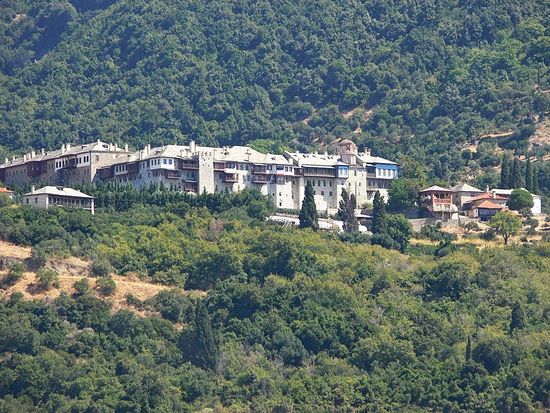
THE LARGEST PIECE OF THE TRUE CROSS OF CHRIST—HOLY MONASTERY OF XEROPOTAMOU, MOUNT ATHOS

Xeropotamou, thirteen pieces of the True Cross of Jesus Christ are treasured, four large pieces in ancient reliquaries and nine smaller pieces which are also housed in reliquaries with other relics of saints.

THE PREACHING OF THE CROSS

A homily on the commemoration of the Procession of the Cross and the Seven Maccabean Marytrs with their mother Solomonia and the priest Eleazar.

Fr. Seraphim Holland

In the name of the Father, the Son and the Holy Spirit. Amen.

Brothers and sisters, today is the Procession of the Cross which we celebrate on the first of August, and also the holy Maccabean martyrs with their teacher Eleazar and their mother Solomonia. And we read today about the Cross in two readings, both because of the feast of the Procession and also because of the martyrs, because the martyrs followed the way of the Cross. Now St. Paul has two famous phrases that are in one of the epistles we read today—a very misunderstood phrase. Let’s talk about what it really means.

The Sign of the Cross in the Old Testament

In his first epistle to the Corinthians Saint Paul mentions that the “Jews seek a sign” (I Cor. 1, 22), that they wanted a supernatural sign, such as the resurrection of the dead, cure of the possessed, and so on that would allow them to believe in the teaching concerning the Cross. So they looked for some supernatural sign, ignoring and overlooking the signs and wonders that God had already shown them in the past, every time they were in danger. Of course, the sign they were seeking could hardly have been anything other than that of the Cross, which, on the one hand, was prefigured throughout the Old Testament and, on the other, was permanently present and saved the people of Christ from destruction and annihilation.
THE SPIRITUAL EXALTATION OF THE CROSS

St. Theophan the Recluse

From: Letters on the Spiritual Life

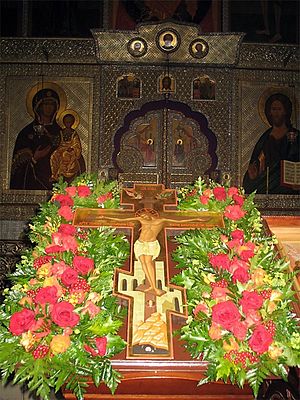
The Exaltation of the Lord’s Cross has arrived. Then the Cross was erected on a high place, so that the people could see it and render honor to it. Now, the cross is raised in the churches and monasteries. But this is all external. There is a spiritual exaltation of the cross in the heart. It happens when one firmly resolves to crucify himself, or to mortify his passions—something so essential in Christians that, according to the Apostle, they only are Christ’s who have crucified their flesh with its passions and lusts (cf. Gal. 5:24). Having raised this cross in themselves, Christians hold it exalted all their lives. Let every Christian soul ask himself if this is how it is, and let him hearken to the answer that his conscience gives him in his heart. Oh, may we not hear, “You only please your flesh in the passions; your cross is not exalted—it is thrown into the pit of the passions, and is rotting there in negligence and contempt!”

Archpriest Andrew Phillips

In the Name of the Father and of the Son and of the Holy Spirit.

As Orthodox Christians we all know how important the Cross is in our Faith. The Cross is the central fact of the Faith, it is not only where Christ was crucified, as we have heard in today's Gospel, but it is also where Christ is risen from the dead. It is also written elsewhere in the Gospels that by losing our life through the Cross, we save our life. In other words if we live for Christ, we will save our life. However, if we live for ourselves, we will lose our life. This is the law of our being and we can see it in all areas of human life.

The spoilt child who lives for himself will not share his toys. Thus he is lonely and bored, he has no-one to play with. His life is lost.

The Mystery of the Cross and the Resurrection of Christ

By Metropolitan Hierotheos of Nafpaktos

Christ's sacrifice on the Cross at Golgotha, which is closely linked to the Resurrection of Christ, is the central point in the teaching and life of the Church. And we also speak of the mystery of the Cross and Resurrection of Christ in regards to the victory of Christ over sin, the devil and death.

There is a distinction between "the bodily Crucifixion and Resurrection of the incarnate Word of God" and "the mystery of the power of the Cross and the Resurrection of Christ, witnesses of which were the Prophets and some Apostles before the sacrifice on the Cross at Golgotha." Despite this distinction, there is a close relationship between the mystery of the Cross and the sacrifice of Christ on the Cross at Golgotha.

The Meaning of the Cross and the Resurrection

The following interview was conducted by George Vassiliou with His Eminence Metropolitan Hierotheos of Nafpaktos. It was originally published in Επίκαιρα της Αιτωλοακαρνανίας, then republished inParemvasis (April 1998).

What is the meaning of Orthodox Holy Week?

Holy Week in the Orthodox Church is the center of its life, its heart. It is preceded by a period of fifty days of asceticism, fasting and prayer, and after Pascha there follows another period of fifty days. In the first period the primary meaning is our preparation for a worthy veneration of the Cross and Resurrection of Christ, and in the second period that which dominates is the struggle to process with spiritual "digestion" this heavenly food. If one examines that every Sunday we celebrate the Cross and Resurrection of Christ, then they can understand that the spirit and atmosphere of Holy Week dominates more than half of the annual cycle and, to express myself better, the message of Holy Week and Pascha permeates throughout the year.

The Cross, the Preserver of the Universe

By St. John Maximovitch

In the prophet Ezekiel (9:6) it is said that when the Angel of the Lord was sent to punish and destroy the sinning people, it was told him not to strike those on whom the “mark” had been made. In the original text this mark is called “tau,” the Hebrew letter corresponding to the letter “T,” which is how in ancient times the cross was made, which then was an instrument of punishment.

And so, even then was foretold the power of the Cross, which preserves those who venerate it. Likewise by many other events in the Old Testament the power of the Cross was indicated. Moses, who held his arms raised in the form of a cross during the battle, gave victory to the Israelites over the Amalekites. He also, dividing the Red Sea by a blow of his rod and by a transverse blow uniting the waters again, saved Israel from Pharaoh, who drowned in the water, while Israel crossed over on the dry bottom (Exodus, Chs. 14, 17).

Elder Paisios on Demons and the Power of the Cross

Elder Paisios was asked the following regarding demons (called "tagalakia" by some Greeks) and the power of the Cross:

- Elder, my thoughts tell me that the devil, especially nowadays, has a lot of power.

- The devil has evil and hatred, not power. The love of God is all-powerful. Satan tries to appear all-powerful, but he does not succeed. He seems strong, but he is completely weak. Many of his destructive plans are spoiled before they even begin to be manifested. Would a very good father allow some punks to hit his children?

- Elder, I'm afraid of tagalakia.

- What is there to fear? Tagalakia have no power. Christ is all-powerful. Temptation is rotten to the core. Don't you wear a Cross? The devil's weapons are weak. Christ has armed us with His Cross. Only when we discard our spiritual weapons, then the enemy has power. An Orthodox priest showed a small Cross to a magician, which made the demon he invoked through his magic tremble.

On the Precious and Life-Giving Cross

Saint Iosif the Confessor

a) Today is the feast of the Cross; let the choirs of angels rejoice. The Cross appears; let the whole congregation of the Church reverence it. The divine power of the Cross is elevated; let the hosts of demons be put to flight. But, divine cross, the inexpressible spectacle of the angels, the boast of the faithful, the royal sceptre- I speak to you as though you were a living thing- you, of course, have brought to us the joyful tidings of salvation. Through you, the barred gates of Paradise have been opened again.

EXALTATION OF THE CROSS

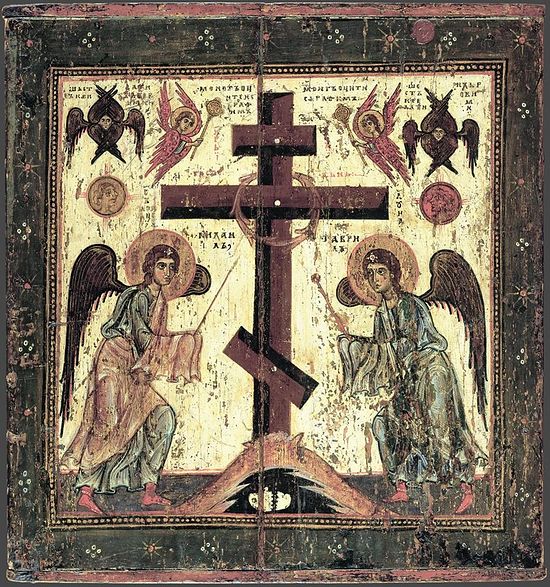
September 14/27. The Exaltation of the Cross is one of the twelve great feasts in the yearly Church cycle. It commemorates two historical events: first, the finding of the Life-giving Cross in the year 326, and second, its recovery from Persia in 628.

History of the Feast

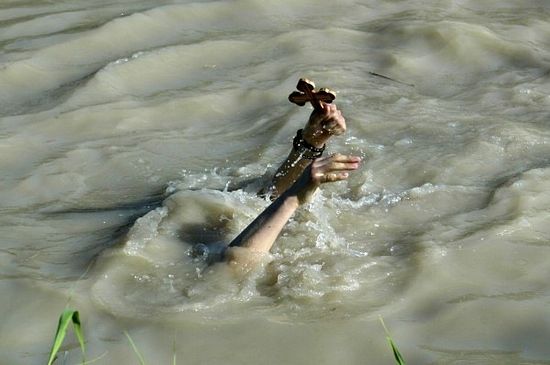
The ceremony of exalting the Cross. Photo: G.Balayants / Expo.Pravoslavie.RuIn the first centuries of Christianity, during the years of persecution, the pagans wished to destroy all evidence of the life of Jesus Christ, and the Cross on which He was crucified disappeared. With the conversion of Emperor Constantine the Great, Christians were at liberty to worship openly and build churches. The emperor's mother, St. Helen, longed to find the True Cross of Christ. She traveled to Jerusalem and was told by a very old Jew that the Cross was buried beneath the temple of the pagan goddess Venus, built in 119 AD by the Roman Emperor Hadrian.

THE EXALTATION OF THE CROSS

Archpriest Andrew Phillips

In the Name of the Father and of the Son and of the Holy Spirit.

As Orthodox Christians we all know how important the Cross is in our Faith. The Cross is the central fact of the Faith, it is not only where Christ was crucified, as we have heard in today's Gospel, but it is also where Christ is risen from the dead. It is also written elsewhere in the Gospels that by losing our life through the Cross, we save our life. In other words if we live for Christ, we will save our life. However, if we live for ourselves, we will lose our life. This is the law of our being and we can see it in all areas of human life.