Brethren and Fathers, Easter is now here, the festive day that brings us joy and gladness, the day of Christ’s Resurrection, which comes round once a year, or, to put it better, occurs daily and perpetually in those who know its mystery, filling our hearts with joy and inexpressible elation. At the same time, it marks the end of the efforts of the holy fast, or, better, has perfected our souls and has, at the same time, comforted them. So, as you see, it has summoned all the faithful to rest and thanksgiving.
Showing posts with label The Second Sunday of Pascha - Thomas Sunday. Show all posts
Bishop John of Worcester and New England
A prophet is one who speaks for God. Because of the Resurrection, because we are Christians, because in our baptisms we put on Christ, we are already prophets. It is our vocation as Christians to incarnate the Divine Logos, the Word of God. It is our sacred duty to reclaim the space we live in and to reveal God to the world. It is our life to witness to the good news and share it with all of God’s creation. It is our life to speak Truth and witness to God in His world. It is our job to speak to the world, revealing what God teaches, wants, and is.
St. John Chrysostom's Homily On the Cemetery and the Cross (Excerpts)
On Tuesday of St. Thomas week we remember those Orthodox Christians from all ages who have died in faith, and in the hope of resurrection. In the Slavic Churches this day is known as Radonitsa.
One remarkable sermon that has yet to be translated into the English language is a homily by St. John Chrysostom which bears the curious name, "On the Cemetery's Name and the Cross." The actual title of the sermon could be something like, "Why A Cemetery Is Named Thus." This homily is traditionally read during the services for the Tuesday of St. Thomas because it was originally delivered on this day. In this particular homily, Saint John explains why the place where we bury our brothers and sisters who have reposed is called a cemetery, a place of sleep, a dormitory, (koimêtêrion in Greek), and not as it was formerly, a necropolis, that is, a city of the dead, or a graveyard.
The Risen Christ, A Test of Logic
By Photios Kontoglou
A Christian's faith is tested with the Resurrection of Christ as gold in the furnace. Of the entire Gospel, the Resurrection of Christ is the most unbelievable thing, totally incomprehensible logically, a true torture for it. But because it is a thing altogether incredible, this is why our whole faith is needed to believe it. We humans often say that we have faith, but we only have it for what is believed by the mind. But then there is no need for faith, since logic is enough. Belief is needed for the unbelievable.
The Mystical Resurrection of Christ
The following discourse is from the catecheses of St. Symeon the New Theologian to the monks of the Monastery of St. Mamas, where he served as Abbot. It is translated from the Greek edition by Archbishop Basil Krivoshein, Syméon le Nouveau Théologien,Catéchèses, Vol. II, Discourse 13, (Sources Chrétiennes, No. 104; Paris: Cerf, 1964), pp. 191-202.
Concerning the Resurrection of Christ: In what it consists, or how Christ’s resurrection takes place in us, and in it the resurrection of the soul. The mystery of this Resurrection. Delivered on the Monday of the second week of Pascha.
Why is the Sunday After Pascha dedicated to the Apostle Thomas?
Hieromonk Job (Gumerov)
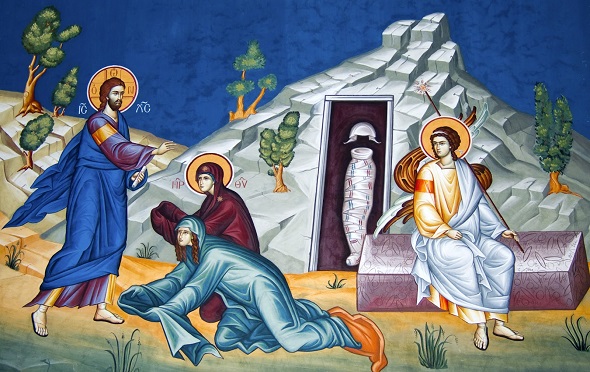
Belief in the great miracle of the Resurrection did not come to the disciples right away. The first witnesses were the myrrh-bearing women. It was still dark out when they came to the cave in the garden belonging to Joseph of Arimathea. The stone which had sealed the tomb was now rolled away. While they stood in astonishment, an Angel stood before them and said, Fear not ye: for I know that ye seek Jesus, which was crucified. He is not here: for he is risen, as he said. Come, see the place where the Lord lay (Mt. 28:5–6). It was enough for them to see the empty tomb and hear the words of the Angel in order for them to believe. Their sensitive and loving hearts were not touched by doubt. When they ran to tell the Apostles, Jesus Himself met them and said, All hail. And they came and held him by the feet, and worshipped him (Mt. 28:9). The Apostles did not believe the women (cf. Mk. 16:11).
Archpriest Alexei Uminsky
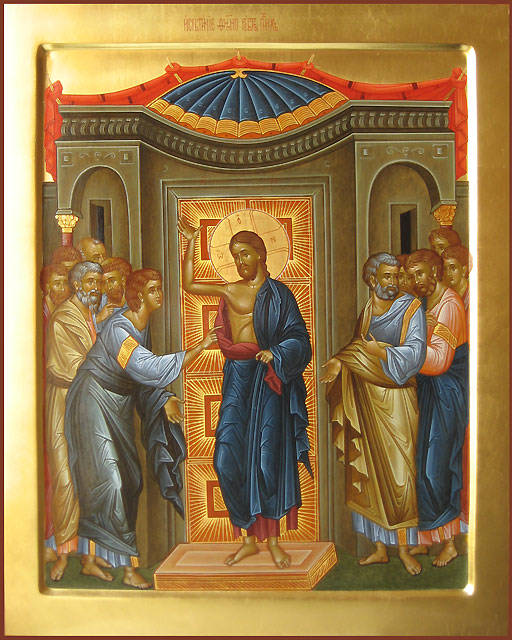
Then the same day at evening, being the first day of the week, when the doors were shut where the disciples were assembled for fear of the Jews, came Jesus and stood in the midst, and saith unto them, Peace be unto you. And when He had so said, He shewed unto them His hands and His side...
Second Sunday After Pascha:
Feast Of The Sunday Of Thomas
Introduction
The Orthodox Church observes the Sunday of Thomas one week following the celebration of the Sunday of Holy Pascha. The day commemorates the appearance of Christ to His disciples on the evening of the Sunday following Passover. It also commemorates the appearance of the Lord to His disciples eight days later when Thomas was present and proclaimed My Lord and my God upon seeing the hands and side of Christ.
This Sunday is also called Antipascha (meaning in the stead of Pascha, not in opposition to Pascha) because with this day, the first Sunday after Pascha, the Church consecrates every Sunday of the year to the commemoration of Pascha, that is, the Resurrection.
Doubting Thomas
By Protopresbyter Alexander Schmemann
“Unless I see…I will not believe” (John 20:25). So said Thomas, one of Christ’s twelve disciples, in response to the joyful news of those who had seen their crucified and buried Teacher risen from the dead. Eight days later, as recorded in the gospels, when the disciples once again were all together, Christ appeared and told Thomas: “Put your finger here and see my hands; and put out your hand and place it in my side; be not faithless, but believing.” And Thomas exclaimed: “My Lord and my God!” Then Christ told him: “You have believed because you have seen me; blessed are those who have not seen and yet believe…” (John 20:24-31).
Thomas Didn't Believe
So That All May Believe
by St. Gregory the Great
Thomas, one of the twelve, called the Twin, was not with them when Jesus came. He was the only disciple absent; on his return he heard what had happened but refused to believe it. The Lord came a second time; He offered His side for the disbelieving disciple to touch, held out His hands, and showing the scars of His wounds, healed the wound of his disbelief.
Subscribe to:
Posts (Atom)