On the Sunday before the Nativity of Christ, we read the Gospel lesson from Matthew 1:1-25, the genealogy of our Lord Jesus Christ.
Showing posts with label St. Gregory Palamas. Show all posts
Homily on the Holy Nativity
On the Saving Nativity According to the Flesh of our Lord and God and Saviour Jesus Christ
This is the Festival of the virgin birth! Our address must be exalted therefore in accordance with the greatness of the feast, and enter into the mystery, as far as this is accessible and permissible, and time allows, that something of its inner power might be revealed even to us. Please strive, brethren, to lift up your minds as well, that they may better perceive the light of divine knowledge, as though brightly illuminated by a holy star. For today I see equality of honour between heaven and earth, and a way up for all those below to things above, matching the condescension of those on high. However great the heaven of heavens may be, or the upper waters which form a roof over the celestial regions, or any heavenly place, state or order, they are no more marvellous or honourable than the cave, the manger, the water sprinkled on the infant and His swaddling clothes. For nothing done by God from the beginning of time was more beneficial to all or more divine than Christ’s nativity, which we celebrate today.
Entry of the Mother of God into the Temple
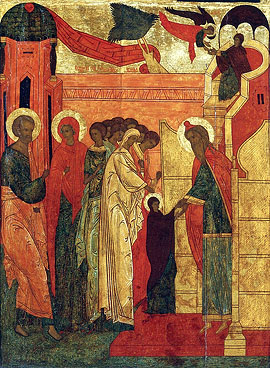
Entry in the Temple. Icon fragment, 16th century.If a tree is known by its fruit, and a good tree bears good fruit (cf. Mt. 7:17; Lk. 6:44), then is not the Mother of Goodness Itself, She who bore the Eternal Beauty, incomparably more excellent than every good, whether in this world or the world above? Therefore, the coeternal and identical Image of goodness, Preeternal, transcending all being, He Who is the preexisting and good Word of the Father, moved by His unutterable love for mankind and compassion for us, put on our image, that He might reclaim for Himself our nature which had been dragged down to uttermost Hades, so as to renew this corrupted nature and raise it to the heights of Heaven. For this purpose, He had to assume a flesh that was both new and ours, that He might refashion us from out of ourselves. Now He finds a Handmaiden perfectly suited to these needs, the supplier of Her own unsullied nature, the Ever-Virgin now hymned by us, and Whose miraculous Entrance into the Temple, into the Holy of Holies, we now celebrate. God predestined Her before the ages for the salvation and reclaiming of our kind. She was chosen, not just from the crowd, but from the ranks of the chosen of all ages, renowned for piety and understanding, and for their God-pleasing words and deeds.
Sermon on the Myrrhbearing Women
The resurrection of the Lord is the regeneration of human nature. It is the resuscitation and re-creation of the first Adam, whom sin led to death, and who because of death, again was made to retrace his steps on the earth from which he was made. The resurrection is the return to immortal life. Whereas no one saw that first man when he was created and given life—because no man existed yet at that time—woman was the first person to see him after he had received the breath of life by divine inbreathing.
The Very Word of God from God Emptied Himself in an Indescribable Way
St. Gregory Palamas
He who produced all earthly and heavenly things out of non-being, when He saw that His rational creatures were brought to nothing because of their desire for something greater (Genesis 3.5), bestowed upon them Himself…
…in order that from that time forward we might exercise our desire for something better without risk, although in the beginning we fell into the ultimate danger on that account (1 Corinthians 15.26),
and in order that each of us, in desiring to become God, might not only be blameless, but also attain to our longing.
The Pre-Eternal and Uncircumscribed and Almighty Word is Now Born according to the Flesh
This is the Festival of the virgin birth!
[...] Today I see equality of honour between heaven and earth, and a way up for all those below to things above, matching the condescension of those on high.
However great the heaven of heavens may be, or the upper waters which form a roof over the celestial regions, or any heavenly place, state or order, they are no more marvellous or honourable than the cave, the manger, the water sprinkled on the infant and His swaddling clothes.
THE ENTRY INTO THE TEMPLE OF THE MOST HOLY MOTHER OF GOD
If a tree is known by its fruit, and a good tree bears good fruit (cf. Mt. 7:17; Lk. 6:44), then is not the Mother of Goodness Itself, She who bore the Eternal Beauty, incomparably more excellent than every good, whether in this world or the world above? Therefore, the coeternal and identical Image of goodness, Preeternal, transcending all being, He Who is the preexisting and good Word of the Father, moved by His unutterable love for mankind and compassion for us, put on our image, that He might reclaim for Himself our nature which had been dragged down to uttermost Hades, so as to renew this corrupted nature and raise it to the heights of Heaven. For this purpose, He had to assume a flesh that was both new and ours, that He might refashion us from out of ourselves. Now He finds a Handmaiden perfectly suited to these needs, the supplier of Her own unsullied nature, the Ever-Virgin now hymned by us, and Whose miraculous Entrance into the Temple, into the Holy of Holies, we now celebrate. God predestined Her before the ages for the salvation and reclaiming of our kind. She was chosen, not just from the crowd, but from the ranks of the chosen of all ages, renowned for piety and understanding, and for their God-pleasing words and deeds.
ENTRY OF THE MOTHER OF GOD INTO THE TEMPLEe
St. Gregory Palamas,
Entry in the Temple. Icon fragment, 16th century.If a tree is known by its fruit, and a good tree bears good fruit (cf. Mt. 7:17; Lk. 6:44), then is not the Mother of Goodness Itself, She who bore the Eternal Beauty, incomparably more excellent than every good, whether in this world or the world above? Therefore, the coeternal and identical Image of goodness, Preeternal, transcending all being, He Who is the preexisting and good Word of the Father, moved by His unutterable love for mankind and compassion for us, put on our image, that He might reclaim for Himself our nature which had been dragged down to uttermost Hades, so as to renew this corrupted nature and raise it to the heights of Heaven. For this purpose, He had to assume a flesh that was both new and ours, that He might refashion us from out of ourselves. Now He finds a Handmaiden perfectly suited to these needs, the supplier of Her own unsullied nature, the Ever-Virgin now hymned by us, and Whose miraculous Entrance into the Temple, into the Holy of Holies, we now celebrate. God predestined Her before the ages for the salvation and reclaiming of our kind. She was chosen, not just from the crowd, but from the ranks of the chosen of all ages, renowned for piety and understanding, and for their God-pleasing words and deeds.
The Shareable and non-Shareable God according to St Gregory Palamas
The endeavours and teaching of Saint Gregory Palamas were directed at ensuring that people could enjoy the possibility of participating in God, at demonstrating that God is not merely completely transcendental and beyond involvement but is also here with us in the world and welcomes our involvement with Him. Gregory correctly saw, in Varlaam’s views, the renewal of the theological heresies of the 4th century, those of Evnomios, Areios, and Makedonios, who, by accepting the Son and Holy Spirit as creations, deprived people of the chance of glorification [deification]. Because how could They glorify people if They Themselves were also creations and in need of deification, as Gregory the Theologian so succinctly and provocatively says about the Holy Spirit: “unless the Holy Spirit is deified first and thus deified with those of equal value”.
Homily on the Entrance of the Theotokos into the Temple
By St. Gregory Palamas
If a tree is known by its fruit, and a good tree bears good fruit (Mt. 7:17; Lk. 6:44), then is not the Mother of Goodness Itself, She who bore the Eternal Beauty, incomparably more excellent than every good, whether in this world or the world above? Therefore, the coeternal and identical Image of goodness, Preeternal, transcending all being, He Who is the preexisting and good Word of the Father, moved by His unutterable love for mankind and compassion for us, put on our image, that He might reclaim for Himself our nature which had been dragged down to uttermost Hades, so as to renew this corrupted nature and raise it to the heights of Heaven. For this purpose, He had to assume a flesh that was both new and ours, that He might refashion us from out of ourselves. Now He finds a Handmaiden perfectly suited to these needs, the supplier of Her own unsullied nature, the Ever-Virgin now hymned by us, and Whose miraculous Entrance into the Temple, into the Holy of Holies, we now celebrate. God predestined Her before the ages for the salvation and reclaiming of our kind. She was chosen, not just from the crowd, but from the ranks of the chosen of all ages, renowned for piety and understanding, and for their God-pleasing words and deeds.
At the beginning of the Nativity Fast: St Gregory Palamas – On Fasting
Taken from HOMILY SIX – TO ENCOURAGE FASTING
by Saint Gregory Palamas
(INCLUDING A BRIEF WORD ON THE ORIGIN OF THE WORLD)
THE INVISIBLE SERPENT, the originator of evil, is inventive, versatile and extremely skillful in contriving wickedness. He has means to hinder our good purposes and actions as soon as they begin. But if he fails to prevent them initially, he sets up other devices by which he can render them useless once they are underway. If he is unable to make them worthless when they are half way to completion, he knows other tricks and ways to invalidate them even once they are finished, and makes them a source not of reward but of harm to all but the most careful. First of all he points out how laborious and difficult to accomplish virtue is. In this way he fills us with laziness and despair, as though we were attempting difficult and impossible things and were therefore incapable of putting our intentions into action. Then he engenders disbelief in the rewards which God has promised to those who struggle.
A HOMILY ON THE DORMITION OF OUR SUPREMELY PURE LADY THEOTOKOS AND EVER-VIRGIN MARY
By St. Gregory Palamas
Both love and duty today fashion my homily for your charity. It is not only that I wish, because of my love for you, and because I am obliged by the sacred canons, to bring to your God-loving ears a saving word and thus to nourish your souls, but if there be any among those things that bind by obligation and love and can be narrated with praise for the Church, it is the great deed of the Ever-Virgin Mother of God. The desire is double, not single, since it induces me, entreats and persuades me, whereas the inexorable duty constrains me, though speech cannot attain to what surpasses it, just as the eye is unable to look fixedly upon the sun. One cannot utter things which surpass speech, yet it is within our power by the love for mankind of those hymned, to compose a song of praise and all at once both to leave untouched intangible things, to satisfy the debt with words and to offer up the first fruits of our love for the Mother of God in hymns composed according to our abilities.
| Dormition of the Mother of God. Icon. 15th century, Novgorod. Russian Museum, St. Petersburg. |
Feast of St Peter and St Paul (1) – St Peter’s Healing Repentance
Gregory Palamas:
The first traitor, who incited the first man to desert God, saw Him Who had earlier made Adam, the father of the human race, later re-creating Peter as the father of all true worshippers.
He not only saw, but also heard the Creator saying to Peter: “Thou art Peter, and upon this rock I will build my church” (Matt. 16:18).
Once the prince of evil found this out…, he tempted Peter, the first leader of God’s faithful people, as he had previously tempted Adam, the founder of the race of men.
On Pentecost
by St. Gregory Palamas
On How the Holy Spirit Was Manifested and Shared Out at Pentecost; Also About Repentance
1. A SHORT while ago, with the strong eyes of faith, we beheld Christ ascending, no less clearly than those accounted worthy to be eye-witnesses, nor are we less favoured than they. "Blessed are they that have not seen, and yet have believed", says the Lord (John 20:29), referring to those who have found assurance through hearing, and see by faith. Recently we saw Christ lifted up from the ground bodily (Acts 1:9). Now, through the Holy Spirit sent by Him to His disciples, we see how far Christ ascended and to what dignity He carried up the nature He assumed from us. Clearly He went up as high as the place from which the Spirit sent by Him descended. He Who spoke through the Prophet Joel showed us whence the Spirit comes, saying, "I will pour out my spirit upon all flesh" (Joel 2:28), and to Him David addressed the words, "Thou sendest forth thy spirit, they are created: and thou renewest the face of the earth" (Ps. 104:30). It follows that at His Ascension Christ went up to the Father on high, as far as His Fatherly bosom, from which comes the Spirit. Having been shown, even in His human form, to share the Father's glory, Christ now sent forth the Spirit Who comes from the Father and is sent by Him from heaven. But when we hear that the Spirit was sent by the Father and the Son, this does not mean that the Spirit has no part in their greatness, for He is not just sent, but also Himself sends and consents to be sent.
by Saint Gregory Palamas
The resurrection of the Lord is the regeneration of human nature. It is the resuscitation and re-creation of the first Adam, whom sin led to death, and who because of death, again was made to retrace his steps on the earth from which he was made. The resurrection is the return to immortal life. Whereas no one saw that first man when he was created and given life—because no man existed yet at that time—woman was the first person to see him after he had received the breath of life by divine inbreathing. For after him, Eve was the first human being. Likewise no one saw the second Adam, who is the Lord, rise from the dead, for none of his followers were near by and the soldiers guarding the tomb were so shaken that they were like dead men. Following the resurrection, however, it was a woman who saw Him first before the others, as we have heard from Saint Mark’s Gospel today. "After his resurrection Jesus appeared on the morning of the Lord’s Day [Sunday] to Mary Magdalene first."
Subscribe to:
Posts (Atom)