Showing posts with label St. John Chrysostom. Show all posts

THE NATIVITY SERMON OF ST. JOHN CHRYSOSTOM

Icon of the Nativity of Christ.
 St. John Chrysostom

BEHOLD a new and wondrous mystery

My ears resound to the Shepherd’s song, piping no soft melody, but chanting full forth a heavenly hymn. The Angels sing. The Archangels blend their voice in harmony. The Cherubim hymn their joyful praise. The Seraphim exalt His glory. All join to praise this holy feast, beholding the Godhead here on earth, and man in heaven. He Who is above, now for our redemption dwells here below; and he that was lowly is by divine mercy raised.

Bethlehem this day resembles heaven; hearing from the stars the singing of angelic voices; and in place of the sun, enfolds within itself on every side, the Sun of justice. And ask not how: for where God wills, the order of nature yields. For He willed; He had the power; He descended; He redeemed; all things yielded in obedience to God. This day He Who is, is Born; and He Who is, becomes what He was not. For when He was God, He became man; yet not departing from the Godhead that is His. Nor yet by any loss of divinity became He man, nor through increase became He God from man; but being the Word He became flesh, His nature, because of impassability, remaining unchanged.

The Sunday before Christ's Nativity: St. John Chrysostom on the Genealogy of Christ

Greetings! 
For the past forty days we are called by our Church to prepare for Christ's Nativity. On the Sunday before Christmas, the Genealogy of Christ from the first chapter of St. Matthew is read as one of many preparations for us before Christ's Holy Birth. Below are excerpts from the commentary of St. John Chrysostom on this section of the Holy Gospel. 

The Sunday before Christ's Nativity: St. John Chrysostom on the Genealogy of Christ

“The book of the generation of Jesus Christ, the Son of David, the Son of Abraham.”
Do ye indeed remember the charge, which we lately made you, entreating you to hearken unto all the things that are said with all silence, and mystical quietness? For we are to-day to set foot within the holy vestibule, wherefore I have also put you in mind of the charge.

Jesus’ Walk on the Sea

Saint John Chrysostom: 

‘And when He had sent the multitudes away, He went up into the mountain apart to pray: and when evening came, He was there alone. But the ship was now in the midst of the sea, tossed by waves:for the wind was contrary’.

Why did He go up into the mountain? To teach us that solitude and retirement are good, when we are to pray to God. With this in mind, you see, He continually withdraws into the wilderness, and often spends the whole night in prayer there, teaching us to seek earnestly the quietness in our prayers that the time and place affords. For the wilderness is the mother of quiet; it is a calm harbour, delivering us from all turbulence.

The Apostle Paul: Incorporeal, even though he had a Body

Saint John Chrysostom
More than all other people, it’s Paul who shows us what we are, how noble our nature is and what measure of virtue we’re able to achieve. And now he arises from the place he has arrived at and, in a clear voice, to all those who condemn our nature, he defends us on the Lord’s behalf, urging us towards virtue, stopping the shameless mouths of those who blaspheme and proving that there’s very little difference between us and the angels, if we but guard ourselves.

Without having a different nature, without receiving a different soul, nor living in another world, but, having been brought up on the same land and place, with the same laws and customs, he surpassed all the people who’ve ever lived since our race was founded. Where are those people who say that virtue’s difficult and evil’s easy? Because Paul rejects this, saying: ‘For this slight, momentary affliction is preparing us for an eternal weight of glory beyond all measure.’ And if such afflictions are slight, how much more so are our pleasures.

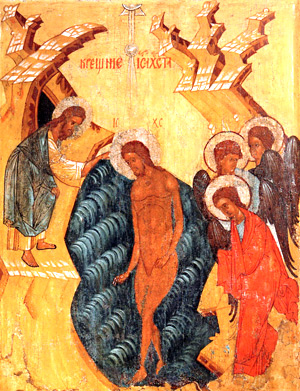
Discourse On the Day of the Baptism of Christ

St. John Chrysostom

We shall now say something about the present feast. Many celebrate the feastdays and know their designations, but the cause for which they were established they know not. Thus concerning this, that the present feast is called Theophany—everyone knows; but what this is—Theophany, and whether it be one thing or another, they know not. And this is shameful—every year to celebrate the feastday and not know its reason.

First of all therefore, it is necessary to say that there is not one Theophany, but two: the one actual, which already has occurred, and the second in future, which will happen with glory at the end of the world. About this one and about the other you will hear today from Paul, who in conversing with Titus, speaks thus about the present: The grace of God hath revealed itself, having saved all mankind, decreeing, that we reject iniquity and worldly desires, and dwell in the present age in prudence and in righteousness and piety—and about the future:Awaiting the blessed hope and glorious appearance of our great God and Saviour Jesus Christ(Tit 2:11-13). And a prophet speaks thus about this latter: The sun shalt turn to darkness, and the moon to blood at first, then shalt come the great and illuminating Day of the Lord(Joel 2:31).

The Twelve Apostles: Timid Men who Won the World

Saint John Chrysostom

An excerpt from a homily by St. John Chrysostom (Hom. 4, 3.4: PG 61, 34-36).

It became clear through unlearned men that the cross was persuasive; in fact, it persuaded the whole world. Their discourse was not of unimportant matters but of God and true religion, of the Gospel way of life and future judgment, and yet it turned ordinary, uneducated men into philosophers. See how the foolishness of God is wiser than people, and his weakness stronger than people!

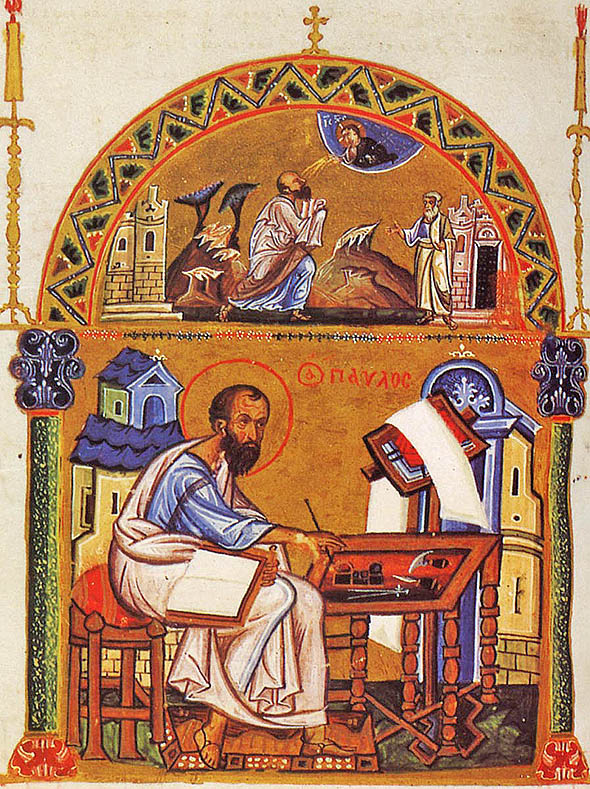
Acquire the Love of Paul and you’ll have a Perfect Crown


Saint John Chrysostom


(Saint John Chrysostom: In Praise of the Holy Apostle Paul, III)

Demonstrating the power of human will and the fact that we can fly even to the heavens themselves, leaving the angels and archangels and the other powers, Saint Paul urges believers to become imitators of Christ, sometimes through him (“Become imitators of me, as I am of Christ.”) and sometimes without him (“Therefore become imitators of God, like beloved children.”).

St Paul Embraced the Whole World and Carried About All Men Within Himself

John Chrysostom 

As I keep hearing the Letters of the Blessed Paul read, sometimes twice a week and often three or four times when we are celebrating the memory of the Holy Martyrs, I rejoice and enjoy hearing this spiritual trumpet, and my desire is inflamed. 

I recognise this voice which is so dear to me and imagine him all but present to my sight and I see him conversing with me. 

But I am sad that all people do not know this man as well as they ought. Some are so ignorant of him that they do not even know for certain how many letters he wrote! 

And this comes not from inability, but from their not having the will to be continually conversing with this holy man. 

Why Go To Church When I Can Just Pray At Home?

St. John Chrysostom answers this question briefly when he writes:

They say: 'We can pray at home.' Thou art deceiving thyself, O man! Of course, one can pray at home. But it is impossible to pray there as in church, where such a multitude of hearts are uplifted to God, merging into one unanimous cry. Thou wilt not be so quickly heard while praying to the Master by thyself, as when praying together with thy brethren, for here in church there is something greater than in thy room: Agreement, unanimity, the bond of love, and finally here are the prayers of the priests. The priests stand before us, then, so that the prayers of the people, being weak, would be united to their more powerful prayers and together with them ascend to heaven. The Apostle Peter was freed from prison, thanks to the common prayers offered for him.... If the Church's prayer was so beneficial for the Apostle Peter and delivered such a pillar of the faith from prison, why, tell me, dost thou disdain its power and what kind of justification canst thou have for this. Hearken unto God Himself, Who says that the multitude of people who pray to him with fervor moves Him to have mercy. He says to the Prophet Jonah: 'Shall I not spare Nineveh, that great city, in which dwell more than 120 thousand people.' He did not simply mention the multitude of people but that thou mightest know that prayer together has great power.

St. John of Kronstadt adds:

Here in church is the one thing needful; here is a refuge from vanity and the storms of life; here is the calm harbor for souls seeking salvation; here is incorrupt food and drink for souls; here is the light, which enlightens every man who comes into the world; here is pure spiritual air; here is the well of living water springing up into everlasting life (John 4:14); here the gifts of the Holy Spirit are distributed; here is the cleansing of souls. The reading and singing in church are performed in a sacred language; all Orthodox Christians must learn it, in order to comprehend the sweet sayings of their mother, who is preparing her children for heaven, for eternal life.... Here in church, a man will come to know the true nobility of his soul, the value of life and its aim or his assigned path; here he dispels the fascination of worldly vanity and worldly passions by acquiring sobriety in his soul; here he comes to know his destiny, both temporal and eternal; here he comes to know his bitter, profound fall and seduction by sin; here the Savior is to be found, ;particularly in His holy and life, creating Mysteries, and His salvation; here a man comes to know his true relationship with God and his neighbor or with his family and the society in which he lives. The church is an earthly heaven, the place where the closest union with the Divinity occurs; it is a heavenly school which prepares Christians for heavenly citizenship, teaching them about the ways of heaven, about the dwellings of heaven; it is the threshold of heaven; it is the place for common prayer, for thanksgiving, for glorifying the Triune God, Who created and preserves everything; it is unity with the angels. What is more precious and more honorable that the church? Nothing. During the divine service, as on a chart, the whole destiny of the human race is depicted, from beginning to end. The divine service is the alpha and omega of the destiny of the world and of men.

Homily on Pentecost by St. John Chrysostom

The Great and Holy Feast of Pentecost 

Let us spiritually extol the grace of the Holy Spirit in spiritual hymns, since spiritual grace has on this day shown upon us from heaven. Though our words are too weak to express adequately the greatness of this grace, we shall praise its power and activity to the extent of our abilities; for the Holy Spirit probes all things, even the depths of divinity.

We are celebrating the day of Pentecost, the day of the Descent of the Holy Spirit to the Apostles, the day of the hope of perfection, the end of expectation, the longing for salvation, the fulfillment of prayer and the image of patience. Today the Spirit Who acted to scatter the nations in the time of Heber has formed tongues of fire among the Apostles. His action of old led to the confusion of the nations, in order to restrain the will of man from its brazenness and consequent chastisement; on this occasion, however, amidst fiery tongues, the deeds wrought by the activity of the Holy Spirit served to preserve us as recipients of preaching, in fulfillment of the will of God.

Homily 56, 57, 58, 59. on the Gospel of John

St. John Chrysostom
5. Sunday after Pasha,
Homilies on the Gospel of John, 

John 9:1-2

And as Jesus passed by, He saw a man which was blind from his birth. And His disciples asked Him, saying, Master, who did sin, this man, or his parents, that he was born blind?

Excerpt from St. John Chrysostom on the healing of the Blind Man

Christ is risen! Truly He is risen!

Excerpt from St. John Chrysostom's homily: "On zeal and piety, and on the man born blind" (amateur translation)

The word of God is a spring of light. The light therefore fills, and the light shines, and illumines the senses of the faithful. For from Him and in Him shines, and those who partake of Him shine. And He does not only enlighten the minds of the faithful, but grants the name of light. For the divine Scripture, for those who dwell with the ignorant and who live in disbelief, rightly calls them darkness, not receiving the lamp of truth, that they might be sons of light. Therefore, the divine Apostle Paul writes: "We were not sons of the night, nor of the darkness, but sons of the light and day." And regarding the sons of light was the evangelical word spoken from the mouth of God: "I am," as Christ said, "the light of the world. He who follows me will not walk in darkness, but will have the light of life."

Homilies on the Gospel of John: Sunday of Samaritan Women

St. John Chrysostom
Homily 31,32,33,34 John 4:5-40

Homilies on the Acts of the Apostles,


St. John Chrysostom,
4. Sunday after Pasha, 
Now they which were scattered abroad upon the persecution that rose about Stephen travelled as far as Phenice, and Cyprus, and Antioch, preaching the word to none but unto the Jews only.Acts XI. 19
The persecution turned out to be no slight benefit as to them that love God all things work together for good. Romans 8:28 

St. John Chrysostom, 
Homilies on the Gospel of John, 
3. Saturday after Pasha, 
John 15:17-16.2

These things I command you, that you love one another.John 15:17
That is, It is not to upbraid, that I tell you that I lay down My life for you, or that I ran to meet you, but in order to lead you into friendship. Then, since the being persecuted and insulted by the many, was a grievous and intolerable thing, and enough to humble even a lofty soul, therefore, after having said ten thousand things first, Christ entered upon this matter. Having first smoothed their minds, He thus proceeds to these points, showing that these things too were for their exceeding advantage, as He had also shown that the others were. For as He had told them that they ought not to grieve, but rather to rejoice, because I go to the Father, (since He did this not as deserting but as greatly loving them,) so here also He shows that they ought to rejoice, not grieve. And observe how He effects this. He said not, I know that the action is grievous, but bear for My sake, since for My sake also ye suffer, for this reason was not yet sufficient to console them; wherefore letting this pass, He puts forward another. And what is that? It is that this thing would be a sure proof of their former virtue. And, on the contrary, you ought to grieve, not because you are hated now but if you were likely to be loved; for this He implies by saying,

St. John Chrysostom, 
Homily 45, 47. 
on the Gospel of John, 
3. Friday after Pasha, 
John 6:48-54

St. John Chrysostom, 
Homilies on the Acts of the Apostles, 
3. Saturday after Pasha
 Acts 9:20-31

And he was with the disciples which were at Damascus certain days. And straightway in the synagogues he preached Jesus, that He is the Son of God. Acts 9:20 See, straightway he was a teacher in the synagogues. He was not ashamed of the change, was not afraid while the very things in which he was glorious afore-time, the same he destroyed. Even from his first appearance on the stage here was a man, death-dealing, ready for deeds of blood: do you see what a manifest sign (was here)?

 St. John Chrysostom, Homilies on the Acts of the Apostles, 
3. Friday after Pasha,
Acts 8:40-9:19


And Saul, yet breathing out threatenings and slaughter against the disciples of the Lord, went unto the high priest, and desired of him letters to Damascus to the synagogues, that if he found any of this way, whether they were men or women, he might bring them bound unto Jerusalem. ch. 9:1-2

St. John Chrysostom, 

Homilies on the Gospel of John, 

3. Thursday after Pasha, 

Jn.6.40-44

And this is the will of Him that sent Me, that every one which sees the Son, and believes in Him, may have everlasting life. John 6:40

Is not then this Your will? And how sayest Thou, I have come to send fire upon the earth, and what have I desired to see, if that be already kindled? Luke 12:49 For if Thou also desirest this, it is very clear that Your will and the Father's is one. In another place also He says, For as the Father raises up the dead and quickens them, even so the Son quickens whom He will. John 5:21
St. John Chrysostom, 
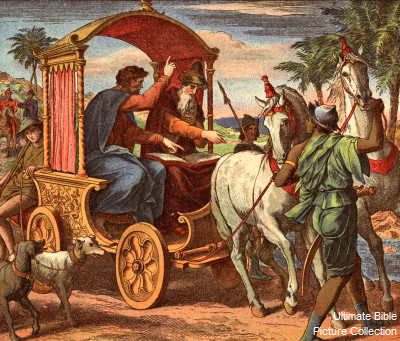
Homilies on the Acts of the Apostles, 
3. Thursday after Pasha
Acts VIII. 26-39 

Acts VIII. 26, 27
And the Angel of the Lord spoke unto Philip, saying, arise and go toward the south unto the way that goes down from Jerusalem unto Gaza, which is desert. And he arose and went.