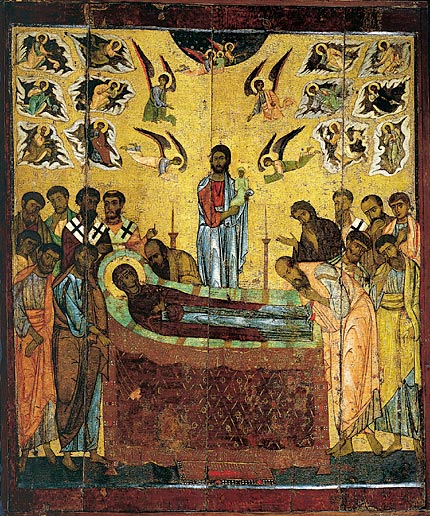
Concerning the Dormition of the Theotokos, this is what the Church has received from ancient times from the tradition of the Fathers. When the time drew nigh that our Savior was well-pleased to take His Mother to Himself, He declared unto her through an Angel that three days hence, He would translate her from this temporal life to eternity and bliss. On hearing this, she went up with haste to the Mount of Olives, where she prayed continuously. Giving thanks to God, she returned to her house and prepared whatever was necessary for her burial. While these things were taking place, clouds caught up the Apostles from the ends of the earth, where each one happened to be preaching, and brought them at once to the house of the Mother of God, who informed them of the cause of their sudden gathering. As a mother, she consoled them in their affliction as was meet, and then raised her hands to Heaven and prayed for the peace of the world. She blessed the Apostles, and, reclining upon he r bed with seemliness, gave up her all-holy spirit into the hands of her Son and God. With reverence and many lights, and chanting burial hymns, the Apostles took up that God-receiving body and brought it to the sepulchre, while the Angels from Heaven chanted with them, and sent forth her who is higher than the Cherubim. But one Jew, moved by malice, audaciously stretched forth his hand upon the bed and immediately received from divine judgment the wages of his audacity. Those daring hands were severed by an invisible blow. But when he repented and asked forgiveness, his hands were restored. When they had reached the place called Gethsemane, they buried there with honor the all-immaculate body of the Theotokos, which was the source of Life. But on the third day after the burial, when they were eating together, and raised up the artos (bread) in Jesus' Name, as was their custom, the Theotokos appeared in the air, saying "Rejoice" to them. From this they learned concerning the bodily translation of the Theotokos into the Heavens. These things has the Church received from the traditions of the Fathers, who have composed many hymns out of reverence, to the glory of the Mother of our God (see Oct. 3 and 4). Apolytikion of Apodosis of the Dormition in the First Tone In birth, you preserved your virginity; in death, you did not abandon the world, O Theotokos. As mother of life, you departed to the source of life, delivering our souls from death by your intercessions

Showing posts with label The Dormition of Our Most Holy Lady Theotokos and Ever Virgin Mary. Show all posts
Showing posts with label The Dormition of Our Most Holy Lady Theotokos and Ever Virgin Mary. Show all posts
The Dormition of the Mother of God
 Ioannis Foundoulis
The feast of the Dormition of the Mother of God is celebrated on August 15 by the Christian world and is the greatest of those established by the Church in honour of the Mother of the Lord. It may be the oldest of all. The first evidence we have for it dates from the 5th century, round about the time when the 3rd Ecumenical Synod was called in Ephesus (451), at which the dogma of the Mother of God was defined and the honour due to her was developed. It appears that it was first held in Jerusalem on 13 August and was transposed soon afterwards to the 15th of the same month. It was a general feast of the Virgin, without particular reference to her Dormition.

A Transition to Life: The Dormition of the Mother of God
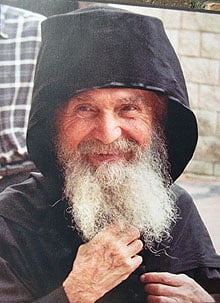
Elder Ephraim of Arizona
Every time we celebrate the Dormition of the Mother of God, it’s as if we’re having Easter – the Easter of the summer. Our Lady the Mother of God prepares Easter for us. A glorious crossing “from death to life”. A second Easter, holy spotless, life-giving for the human race, because today “the laws of nature are overcome”.
“How the source of life goes towards life, passing through death”, says Saint John the Damascan. The death of the life-giving Mother of the Lord transcends the concept of death, so that it’s not even called death, but “dormition” and “divine transition” and an emigration and immigration towards the Lord. And even if it’s called death, it’s a life-bringing death, since it transports to a celestial and immortal life.
Our Lady, the Mother of God and the Paraclitic Canon
Our Most Holy Lady, the Ever-Virgin Mary is a wonder and mystery which not even the angels can understand: “Heaven was astonished and the ends of the earth amazed, for God appeared bodily to mankind, and your bosom became broader than the heavens. Therefore, Mother of God, the leaders of the orders of angels and of men magnify you”, writes the poet of the Paraclitic Canon. She is, as Gregory the Theologian says, “God after God”. Of course, the Fathers also refer to her position elsewhere, clarifying it: “Let Mary be held in honour. Let the Father, Son and Holy Spirit be worshipped, but let no-one worship Mary”, (Saint Epifanios).
Encomium to the Most Holy Mother of God-1
 Saint Epifanios
Wishing to speak, wretch that I am, about the blinding radiance of the Mother of God, her dread and inconceivable powers, the mystery of the heavens and the world, the wonder, the mercy seat, and attempting to refer to the sublime vision and to the miracle in detail, moved to do so by the leaping of my heart, I was seized with great terror and fear. Because the recollection of the dread vision concerning the person of the Mother of God, having filled my soul with terror and brought fear to my heart, did not merely punish me a little, but tormented me greatly. My memory of the very great vision castigates my mind because it does not have the power to speak, since I am dealing with an inconceivable mystery. Who is able to refer to such a mystery?
Excerpt from the homily on the Dormition of the Theotokos
by St. Germanos of Constantinople
“It is time, my Mother,” says the Lord, “to take you to myself. Just as you have filled the earth and all who dwell in it with joy, O you who enjoy such grace, come, and make the heavens joyful once again. Make my Father’s dwelling-place radiant; be a spiritual guide for the souls of the saints. For when they see your glorious passage here to my side, escorted by angels, they will be convinced in their faith that their own place, too, through you, will be to dwell here in my light. Come, then, in exultation; rejoice now, as you rejoiced at the angel’s greeting. In every way you now have the dignity of your title, ‘full of grace.’ As when you were about to conceive me you were invited to rejoice, so rejoice again in my desire to take you to myself. Do not be disturbed at leaving behind the corruptible world, with all its desires. Forget about its power of corruption. For you will not leave those who live in the world bereft of your protection; but just as I, who am not of the world, watch over those who live in it and take care of them, so your patronage will not be taken away from those who live in the world, until its consummation.
THE OF OUR MOST HOLY LADY THEOTOKOS AND EVER VIRGIN MARY
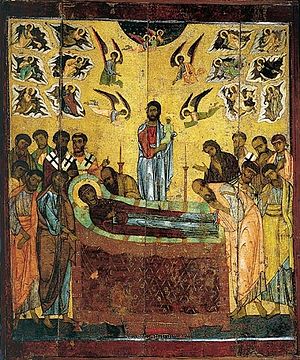
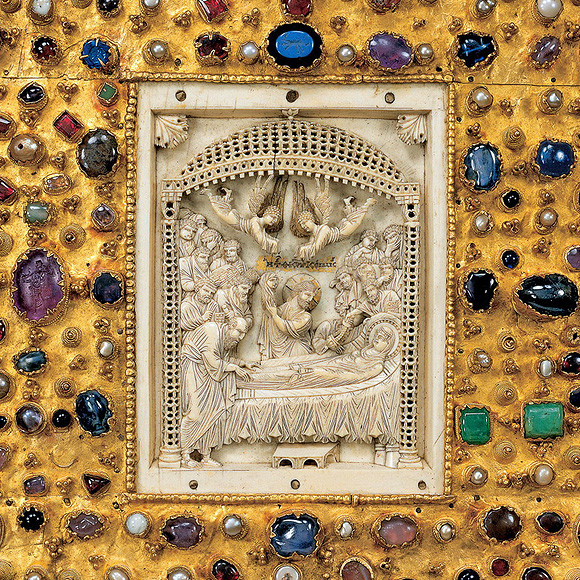
The Dormition of the Mother of God. Early eighth century, Novgorod.
After the Lord’s Ascension, the Mother of God remained under the care of the Apostle John the Theologian, and when he was absent, she lived in the house of his parents, near the Mount of Olives. For all the Apostles and all the faithful, she was a consolation and edification. Talking with them, the Mother of God told them of the wondrous events of the Annunciation, the conception without seed, and her birth of Christ without corruption, His childhood and earthly life. Like the Apostles, she instructed and strengthened others in the Christian Faith by her very presence, words, and prayers. The Apostles’ reverence for the Most Holy Virgin was extraordinary. Upon receiving the Holy Spirit on the remarkable day of Pentecost, they remained in Jerusalem for about ten years, serving for the salvation of the Jews and wishing to see and hear her divine words as often as possible. Many of the newly-enlightened in the faith even came from distant lands to Jerusalem in order to see and hear the Most Pure Theotokos.
SERMON ON THE DORMITION OF THE MOST HOLY THEOTOKOS
St. John of Kronstadt
“Magnify O my soul, the honourable Translation of the Mother of God from earth to heaven.” (Refrain for the 9th Ode of the Canon)
Let us be happy, beloved brothers and sisters that we belong to the Holy Orthodox Church, worthily and rightly glorifying the Most Holy Sovereign Theotokos on this eminent day out of all the days of the year with special solemnity. There exists on earth many societies and entire governments that do not consider the need nor the obligation to call upon and glorify the Queen of heaven and earth, the Mother of Our Divine Lord Jesus Christ, and other saints and angels; to submissively serve Her lovingly, as the true Mother of God. Sadly in Russia nowadays we have heretics (among us) who actively dishonor the Mother of God, the saints, their icons, their relics and their festivals. O, if only they also unanimously with us glorified the worthy Queen of heaven and earth!
“Magnify O my soul, the honourable Translation of the Mother of God from earth to heaven.” (Refrain for the 9th Ode of the Canon)
 |
SERMON ON THE DORMITION OF THE MOTHER OF GOD
 |
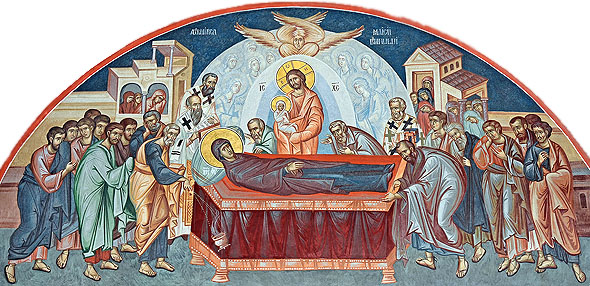
| The Dormition of the Mother of God. |
A HOMILY ON THE DORMITION OF OUR SUPREMELY PURE LADY THEOTOKOS AND EVER-VIRGIN MARY
By St. Gregory Palamas
Both love and duty today fashion my homily for your charity. It is not only that I wish, because of my love for you, and because I am obliged by the sacred canons, to bring to your God-loving ears a saving word and thus to nourish your souls, but if there be any among those things that bind by obligation and love and can be narrated with praise for the Church, it is the great deed of the Ever-Virgin Mother of God. The desire is double, not single, since it induces me, entreats and persuades me, whereas the inexorable duty constrains me, though speech cannot attain to what surpasses it, just as the eye is unable to look fixedly upon the sun. One cannot utter things which surpass speech, yet it is within our power by the love for mankind of those hymned, to compose a song of praise and all at once both to leave untouched intangible things, to satisfy the debt with words and to offer up the first fruits of our love for the Mother of God in hymns composed according to our abilities.
 |
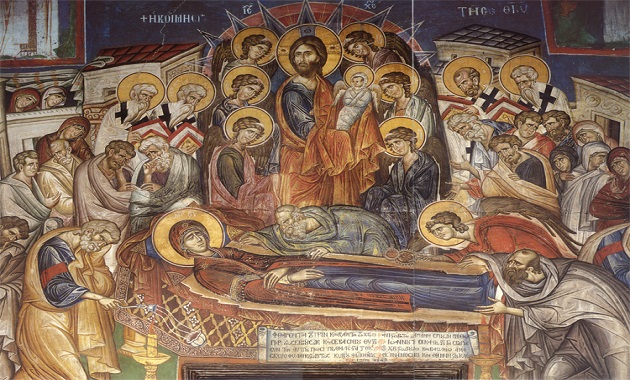
| Dormition of the Mother of God. Icon. 15th century, Novgorod. Russian Museum, St. Petersburg. |
FEAST OF THE DORMITION OF OUR MOST HOLY LADY, THE THEOTOKOS AND EVER-VIRGIN MARY
INTRODUCTION
 |
| Icon of the Dormition of the Theotokos provided by Theologic and used with permission |
BIBLICAL STORY
The Holy Scriptures tell us that when our Lord was dying on the Cross, He saw His mother and His disciple John and said to the Virgin Mary, "Woman, behold your son!" and to John, "Behold your mother!" (John 19:25-27). From that hour, the Apostle took care of the Theotokos in his own home.
Along with the biblical reference in Acts 1:14 that confirms that the Virgin Mary was with the Holy Apostles on the day of Pentecost, the tradition of the Church holds that she remained in the home of the Apostle John in Jerusalem, continuing a ministry in word and deed.
Along with the biblical reference in Acts 1:14 that confirms that the Virgin Mary was with the Holy Apostles on the day of Pentecost, the tradition of the Church holds that she remained in the home of the Apostle John in Jerusalem, continuing a ministry in word and deed.
OUR MOM

By His Eminence Metropolitan Seraphim of Kastoria
Since the glorious years of Byzantium this month has been dedicated to the Honorable Cross, hence on the 1st of August we celebrate the Procession of the Honorable Cross. The Honorable Cross, the Honorable Wood, exited the Sacred Palace where it was kept and it arrived at the Great Church from were for fifteen consecutive days it was brought throughout the entire City for the sanctification of the faithful.
THE VISION OF THE THEOTOKOS COMMUNING THE WEARY FATHERS
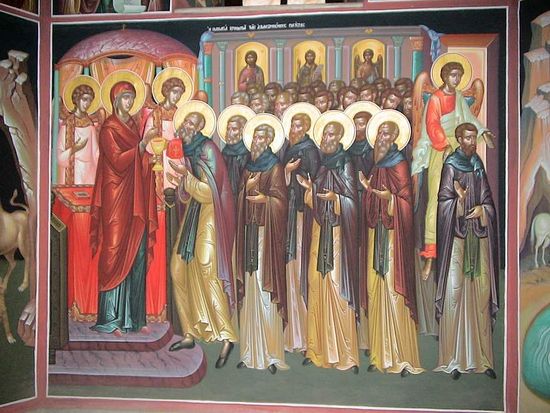
In the time of Saint Savvas there lived in his Lavra many virtuous monks who served the Lord. A noble and wealthy ruler, therefore, went there to live the monastic life, who was welcomed with joy by the Saint.
A STRANGE SCENE IN THE ICON OF THE DORMITION
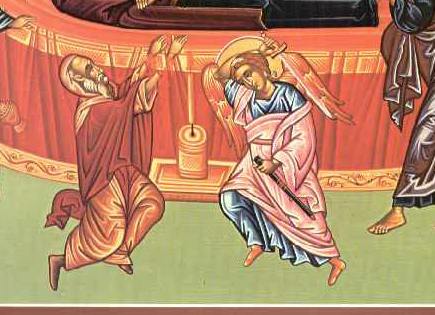
In many icons of the Dormition of the Theotokos, one can see a strange scene near the bottom: an angel invisibly cuts off the two hands of a certain man.
What is the story behind this scene?
Bewailing their separation from the Mother of God, the Apostles prepared to bury Her all-pure body. A solemn procession went from Zion through Jerusalem to the Garden of Gethsemane. Unbelieving inhabitants of Jerusalem, taken aback by the extraordinarily grand funeral procession and vexed at the honor accorded the Mother of Jesus, complained of this to the High Priest and scribes.
Two Understandings of Death: On the Dormition of the Theotokos

In the Name of the Father, and of the Son, and of the Holy Spirit!
Today we mark one of the Twelve Great Feasts, the Dormition of the Most Holy Theotokos. We are celebrating this feast in the principle temple of our Church: the Patriarchal Cathedral of the Dormition in the Moscow Kremlin. Along with the entire Church, we rejoice in an event that has been passed down to us by the Holy Tradition of the Universal Church: the blessed repose of the Most Holy Theotokos, her Dormition, which has become a feast day.
Subscribe to:
Posts (Atom)