How does Christ’s Resurrection take place within us?

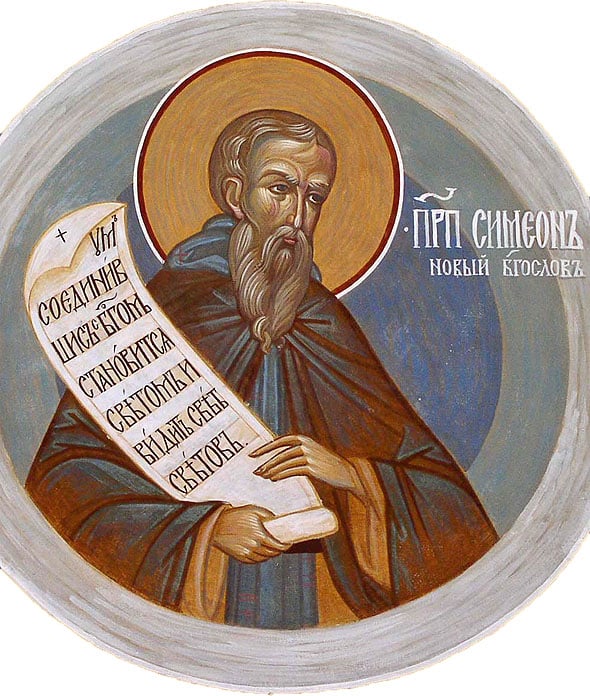
Saint Symeon the New Theologian

Brethren and Fathers, Easter is now here, the festive day that brings us joy and gladness, the day of Christ’s Resurrection, which comes round once a year, or, to put it better, occurs daily and perpetually in those who know its mystery, filling our hearts with joy and inexpressible elation. At the same time, it marks the end of the efforts of the holy fast, or, better, has perfected our souls and has, at the same time, comforted them. So, as you see, it has summoned all the faithful to rest and thanksgiving.

Let us therefore give thanks to the Lord, Who has helped us chart the sea of the fast and has brought us, full of joy, to the haven of His Resurrection.

Sermon on the Myrrhbearing Women

St. Gregory Palamas

The resurrection of the Lord is the regeneration of human nature. It is the resuscitation and re-creation of the first Adam, whom sin led to death, and who because of death, again was made to retrace his steps on the earth from which he was made. The resurrection is the return to immortal life. Whereas no one saw that first man when he was created and given life—because no man existed yet at that time—woman was the first person to see him after he had received the breath of life by divine inbreathing. 

A Paschal Homily of Blessed

Saint Justin Popovic

Sentenced to Immortality

Man sentenced God to death; by His Resurrection, He sentenced man to immortality. In return for a beating, He gives an embrace; for abuse, a blessing; for death, immortality. Man never showed so much hate for God as when he crucified Him; and God never showed more love for man than when He arose. Man even wanted to reduce God to a mortal, but God by His Resurrection made man immortal. The crucified God is Risen and has killed death. Death is no more. Immortality has surrounded man and all the world.

HOMILY ON THE MEETING OF THE LORD

Delivered by His Grace Bishop Atanasije (Jevtic), 1995 in Pozarevac

Today we celebrate a great Feast, the Meeting of the Lord in the Temple, we celerate a joyous event of the Meeting of Heaven and earth, the timeless and the transient, God and man, in the person of the Lord Jesus Christ.

In the Jerusalem Temple the newly born Savior was taken into the arms of the Righteous elder Simeon, who, having received a Divine promise that he would not die until he sees with his own eyes the Savior and Messiah, gave thanks to the Lord at that very moment for fulfiling that promise by saying: „Now you are letting Your servant depart in peace, according to Your word, for my eyes have seen Your salvation...“. Receiving and taking into his elderly hands the Savior of the world, the righteous Elder recognized also in his prophetic vision the full history of what would be with Christ, and all of those who follow Him, and that is why He says to the Most Holy Theotokos: „Behold this Child is destined for the fall and rising, and for a sign which will be spoke against and many will stand against,“ but they will not be able to prevail, for in Him the thoughts of the hearts of many will be revealed.

"The Word became flesh"

A Sermon by St John of Kronstadt 
on the Nativity of Christ

The Word became flesh; that is, the Son of God, co-eternal with God the Father and with the Holy Spirit, became human – having become incarnate of the Holy Spirit and the Virgin Mary. O, wondrous, awesome and salvific mystery! The One Who had no beginning took on a beginning according to humanity; the One without flesh assumed flesh. God became man – without ceasing to be God. The Unapproachable One became approachable to all, in the aspect of an humble servant. Why, and for what reason, was there such condescension [shown] on the part of the Creator toward His transgressing creatures – toward humanity which, through an act of its own will had fallen away from God, its Creator?

The Forefathers of Christ

Fr. Stephen Freeman

Among the greatest blasphemies ever constructed by humankind was that of Nazi Germany. Not satisfied with their political dominance, they also sought a religious dominance as well. The notion of an “Aryan Christ” was perhaps the depths of their theological blasphemies mirrored in their dehumanization and murder of the Jews. At many points in the past two millennia, the relationship between Christians and Jews has hit low points – with the Jews almost universally at the short end of the stick. But to seek to create a Christ who Himself was not a Jew is (for a Christian) the worst of insults.

A Homily on the Nativity


As a Christmas gift to our listeners, the Institute for Orthodox Christian Studies (IOCS) presents a reading of "A Homily on the Nativity" from the book Harp of the Spirit: Poems of St. Ephrem the Syrian, translated by Sebastian Brock and published by IOCS.

BODILY FASTING FOR THE SOUL’S BENEFIT

The Nativity fast begins on November 14/27, and lasts forty days. The Nativity fast is not as strict as Great Lent or the Dormition fast, and can be compared to the Apostle’s fast. It was instituted by the Church so that we would worthily greet the feast of the Nativity of Christ after having cleansed our hearts by prayer and repentance.

A HOMILY FOR THOSE REJOICING IN THE NATIVITY FAST

Our Mother the Church, dear reader, has the custom of preparing her children, well in advance of the actual holy day, for extraordinary events which the central axle of both earthly and eternal existence. Beyond a doubt, the feast of Nativity of Christ, the appearance of God in the flesh, belongs to this very category.

The whole history of humankind, which began with the fall of our forefather and mother, Adam and Eve, the continuation of history through their descendants, the history of peoples and kingdoms (especially the history of ancient Israel), all led up to and arrived at Bethlehem, to the mysterious cave, where Christ the Savior of the world manifested His wondrous infant countenance to us.

THE NATIVITY FAST: A TIME OF PREPARATION

The Fast of the Nativity is the Church's wise solace and aid to human infirmity. We are a forgetful people, but our forgetfulness is not unknown to God; and our hearts with all their misconceptions and weakened understandings are not unfamiliar to the Holy Spirit who guides and sustains this Church. We who fall far from God through the magnitude of our sin, are called nonetheless to be close to Him. We who run afar off are called to return. Through the fast that precedes the great Feast of the Incarnation -- which itself is the the heart and substance of our calling -- the Church helps draw us into the full mystery of what that call entails.