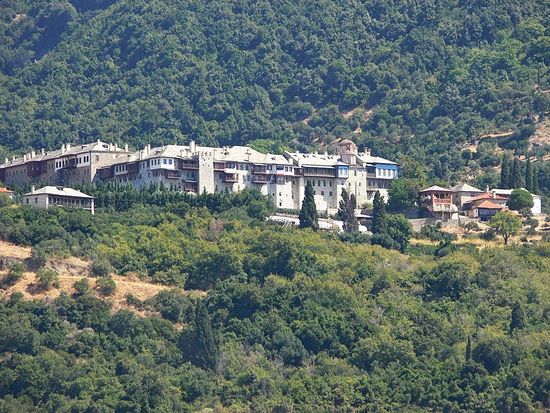
THE LARGEST PIECE OF THE TRUE CROSS OF CHRIST—HOLY MONASTERY OF XEROPOTAMOU, MOUNT ATHOS

Xeropotamou, thirteen pieces of the True Cross of Jesus Christ are treasured, four large pieces in ancient reliquaries and nine smaller pieces which are also housed in reliquaries with other relics of saints.

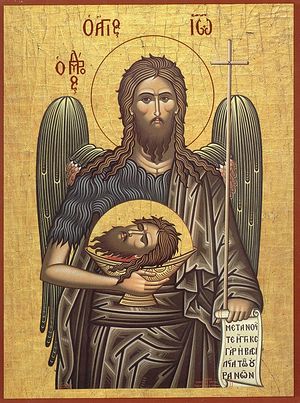
HOMILY ON THE FEAST OF THE BEHEADING OF ST. JOHN THE BAPTIST

St. Justin Popovic

Today is a little Great Friday, a second Great Friday. For today the greatest man among those born of women, John, the Holy Forerunner and Baptiser of the Lord, is murdered. On Great Friday, people murdered God, crucified God. On today’s holy great feast, people murdered the greatest of all men. It is not I who chose to use the expression “the greatest.” What are my praises of the great and glorious Forerunner of the Lord, whom the Lord praised more than anyone among men, more than any of the apostles, the Angels, the Prophets, the Righteous Ones, the Sages? For the Lord declared of him:


Among them that are born of women there hath not risen a greater than John the Baptist… (?atthew 11: 11).

In all Creation, there exists no greater praise.

“Thy birth, O Theotokos, has proclaimed joy to the whole world…”

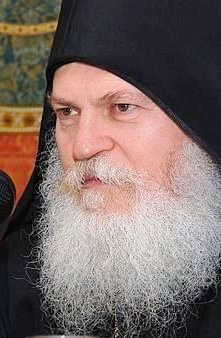
Archimandrite Ephraim, Abbot of the Vatopaidi Monastery

A homily of the abbot of the Great and Holy Monastery of Vatopedi, Archimandrite Ephraim, in the refectory of the monastery at the Feast of the Mother of God on September 8th.

***

The Panagia has a central place in divine worship. Feasts of the Mother of God frame the ecclesiastical year; it begins with the feast of the Birth of the Theotokos, and ends with the feast of the placing of the Holy Girdle of the Theotokos.

Apodosis of the Dormition of our Most Holy Lady the Theotokos and Ever Virgin Mary Reading from the Synaxarion

Concerning the Dormition of the Theotokos, this is what the Church has received from ancient times from the tradition of the Fathers. When the time drew nigh that our Savior was well-pleased to take His Mother to Himself, He declared unto her through an Angel that three days hence, He would translate her from this temporal life to eternity and bliss. On hearing this, she went up with haste to the Mount of Olives, where she prayed continuously. Giving thanks to God, she returned to her house and prepared whatever was necessary for her burial. While these things were taking place, clouds caught up the Apostles from the ends of the earth, where each one happened to be preaching, and brought them at once to the house of the Mother of God, who informed them of the cause of their sudden gathering. As a mother, she consoled them in their affliction as was meet, and then raised her hands to Heaven and prayed for the peace of the world. She blessed the Apostles, and, reclining upon he r bed with seemliness, gave up her all-holy spirit into the hands of her Son and God. With reverence and many lights, and chanting burial hymns, the Apostles took up that God-receiving body and brought it to the sepulchre, while the Angels from Heaven chanted with them, and sent forth her who is higher than the Cherubim. But one Jew, moved by malice, audaciously stretched forth his hand upon the bed and immediately received from divine judgment the wages of his audacity. Those daring hands were severed by an invisible blow. But when he repented and asked forgiveness, his hands were restored. When they had reached the place called Gethsemane, they buried there with honor the all-immaculate body of the Theotokos, which was the source of Life. But on the third day after the burial, when they were eating together, and raised up the artos (bread) in Jesus' Name, as was their custom, the Theotokos appeared in the air, saying "Rejoice" to them. From this they learned concerning the bodily translation of the Theotokos into the Heavens. These things has the Church received from the traditions of the Fathers, who have composed many hymns out of reverence, to the glory of the Mother of our God (see Oct. 3 and 4). Apolytikion of Apodosis of the Dormition in the First Tone In birth, you preserved your virginity; in death, you did not abandon the world, O Theotokos. As mother of life, you departed to the source of life, delivering our souls from death by your intercessions
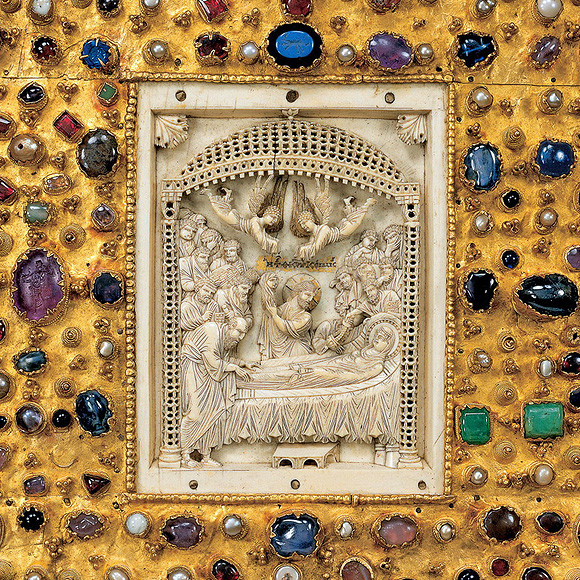
The Dormition of the Mother of God

Ioannis Foundoulis

The feast of the Dormition of the Mother of God is celebrated on August 15 by the Christian world and is the greatest of those established by the Church in honour of the Mother of the Lord. It may be the oldest of all. The first evidence we have for it dates from the 5th century, round about the time when the 3rd Ecumenical Synod was called in Ephesus (451), at which the dogma of the Mother of God was defined and the honour due to her was developed. It appears that it was first held in Jerusalem on 13 August and was transposed soon afterwards to the 15th of the same month. It was a general feast of the Virgin, without particular reference to her Dormition.

A Transition to Life: The Dormition of the Mother of God

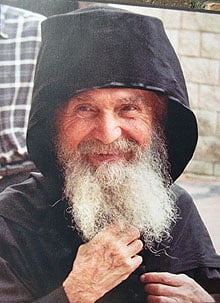
Elder Ephraim of Arizona

Every time we celebrate the Dormition of the Mother of God, it’s as if we’re having Easter – the Easter of the summer. Our Lady the Mother of God prepares Easter for us. A glorious crossing “from death to life”. A second Easter, holy spotless, life-giving for the human race, because today “the laws of nature are overcome”.

“How the source of life goes towards life, passing through death”, says Saint John the Damascan. The death of the life-giving Mother of the Lord transcends the concept of death, so that it’s not even called death, but “dormition” and “divine transition” and an emigration and immigration towards the Lord. And even if it’s called death, it’s a life-bringing death, since it transports to a celestial and immortal life.

EXHORTATION ON THE PRAYER RULE

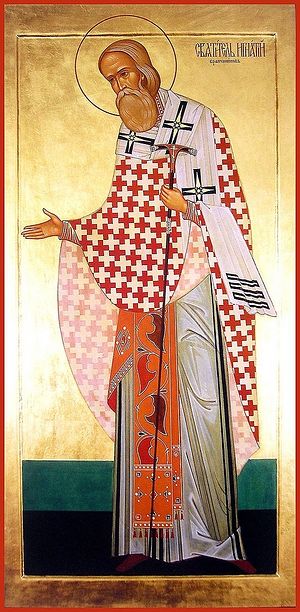
St. Ignatius (Brianchaninov)

Bishop Ignaty (secular name, Dimitry Aleksandrovich Brianchaninov; 1807-1867) was an outstanding ecclesiastical writer and ascetic of the nineteenth century. He had no special theological education. He studied at the main engineering college in St. Petersburg and in 1824 graduated from it, receiving an officer’s rank. During the following four years he fulfilled various obediences as a novice in several monasteries, after which he took monastic vows and was appointed in 1883 as Father Superior of the St. Sergei Hermitage of the St. Petersburg Diocese. He gained profound experience in the knowledge of God by studying the works of the holy fathers. In 1857 he was consecrated bishop of the Black Sea and the Caucasus. In 1861 he retired for reasons of health and settled in the Babaevsky Monastery of St. Nicholas. Besides his feats of prayer and extensive correspondence with his spiritual children, Bishop Ignaty devoted much of his time during these years to literary work. The reader of his works discovers in their author a pastor-ascetic engaged in an intense spiritual combat and who is tragically depressed by setbacks in this struggle. The main motivation behind his ascetic works is his awareness of the damage done to human nature by sin. He wrote: “Our nature is contaminated by sin so that it is quite natural for it to generate unnatural sin” (Essays of Bishop Ignaty Brianchaninov, 3rd edition, St. Petersburg, 1905, Vol. 5, p. 435). “The Christian discerns within himself the human Fall inasmuch as he can see his own passions. Passions are the sign of the sinful mortal disease which afflicts the entire human race” (1.528). “In order to achieve success in the spiritual life, it is necessary for our passions to reveal themselves by coming to the fore. When passions reveal themselves in an ascetic he comes to grips with them” (1.345).

THE RULE OF FASTING IN THE ORTHODOX CHURCH

Hieromonk Seraphim (Rose)

In answer to numerous requests from readers, the rule of fasting is given for each day of the year. Where no indication of fast is given, and during "fast-free weeks," all foods may be eaten (except during Cheese-fare Week, when meat alone is forbidden every day). Where "fast day" is indicated alone, the fast is a strict one, with no meat, eggs, dairy products, fish, wine or oil to be eaten. Where, underneath "fast day," is indicated "wine and oil allowed," the fast is relaxed for the sake of a feast day or vigil, to allow eating of these foods. Where "fish, wine and oil allowed" is indicated, then all three of these foods may be eaten.

WHY THE ORTHODOX HONOR MARY

Fr. Stephen Freeman

The most difficult part of my Orthodox experience to discuss with the non-Orthodox is the place and role of the Mother of God in the Church and in my life. It is, on the one hand, deeply theological and even essential to a right understanding of the Orthodox faith, while, on the other hand, being intensely personal beyond the bounds of conversation. I am convinced, as well, that the Orthodox approach to Mary is part of the apostolic deposit, and not a later accretion.

When I was doing graduate studies some decades back, I decided to concentrate my historical research on the “cult of Mary” (the veneration of Mary) in the historical Church. With that decision came a semester of intensive research, combing through materials of every sort. And throughout all of that research the question, “When did this begin?” was uppermost in my mind. I came to a surprising conclusion. It began at the beginning.