
Kontakion for All Saints by St. Romanos the Melodist

Note: The Proimion I and the first Oikos below are taken from the link below, while the rest of the text following is an amateur translation from the Greek.
Prooimion I
O Planter of creation, Lord, to You does the entire world bring as an offering the God-bearing martyr Saints, as being nature’s first fruits. At their earnest entreaty, keep Your Church in a state of profoundest peace, through the Theotokos, O Lord abundantly merciful.

The Fruits of the Spirit and Living in the Image and Likeness of God
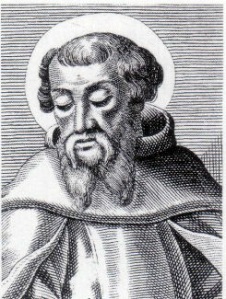
Irenaeus of Lyons:
To save us from forfeiting life by losing the Spirit who possesses us, and to exhort us to share in the Spirit, the Apostle declares that it is impossible for flesh and blood to gain possession of the kingdom of God.
In other words: Do not deceive yourselves, for if the Word of God and the Spirit of the Father do not dwell in you, and you lead a life of vanity and carelessness, as though you were merely flesh and blood, you cannot obtain the kingdom of God.
He says this to prevent us from indulging our physical nature and spurning the grafting of the spirit, for when you were a wild olive, he says, you were grafted into the cultivated olive and came to share that olive’s rich sap.
St Paul Embraced the Whole World and Carried About All Men Within Himself

John Chrysostom
As I keep hearing the Letters of the Blessed Paul read, sometimes twice a week and often three or four times when we are celebrating the memory of the Holy Martyrs, I rejoice and enjoy hearing this spiritual trumpet, and my desire is inflamed.
I recognise this voice which is so dear to me and imagine him all but present to my sight and I see him conversing with me.
But I am sad that all people do not know this man as well as they ought. Some are so ignorant of him that they do not even know for certain how many letters he wrote!
And this comes not from inability, but from their not having the will to be continually conversing with this holy man.
Saint Peter the Apostle: A Great Personality
 Apostolos
Glavenas
Apostolos
Glavenas
Peter was born in Bethsaida, close to
Lake Gennesaret, where, along with his brother Andrew, who also became an
Apostle, they plied the trade of fisherman, together with two other Apostles,
James and John, the sons of Zebedee.
In all the Gospel records he’s first mentioned as Simon, while in other books
of the New Testament he’s called Simeon. He’s also mentioned a good number of
times as Simon Peter, and also as Cephas.
Synaxarion For the Sunday of All Saints
 By
Nikephoros Kallistos Xanthopoulos
By
Nikephoros Kallistos Xanthopoulos
SUNDAY of
All Saints
On this
day, the Sunday after Pentecost, we celebrate the Feast of All Saints who shone
forth throughout the inhabited earth, in Asia, Libya, and Europe, North and
South, East and West.
Verses
All the friends of my Lord do I hymn.If any would, let him make mention of them all.
On the Veneration of the Saint
 by Fr Georges Florovsky
CHRIST HAS CONQUERED THE WORLD. This victory is further unveiled and fulfilled in the fact that He built His Church. In Christ and through Christ the unity of mankind was brought about truly for the first time, for those who believed in His Name become the Body of Christ. And through uniting with Christ they unite likewise with each other in a most sincere concord of love. In this great unity all empirical distinctions and barriers are done away with: differences of birth in the flesh are effaced within the unity of a spiritual birth. The Church is a new people filled with grace, which does not coincide with any physical boundaries or any earthly nation-neither Greeks nor Jews, and a struggle of faith, through the "Mystery of water," through a union with Christ in the "Mysterious font," through the "grace of becoming sons" ; i.e. "sons of God" for Whom were all things created that are in heaven and that are in earth." In Holy Christening the one to be enlightened leaves "this world" and forsakes its vanity, as if freeing himself and stepping out of the natural order of things; from the order of "flesh and blood" one enters an order of grace.
The Fearlessness of the Saints

St. Nikolai Velimirovich
O how great was the fearlessness of the holy men and holy women! When we read
about their lives, both shame and pride is awakened in us unwillingly - shame
that we have lagged so far behind them and pride that they are of our Christian
race. Neither sickness, nor prison, nor exile, nor suffering, nor humiliation,
nor the sword, nor the abyss, nor fire, nor the gallows were able to shake the
exalted peace of their souls, firmly attached to Christ, the Helmsman of the
universe and human history.
When Emperor Julian apostasized from the Faith and began to make waste of
Christianity throughout the entire empire, St. Athanasius the Great quietly
spoke of him to the faithful: "The cloud will pass!". And indeed,
that dark cloud quickly passed and Christianity lowered its roots even deeper
and spread its branches all the more throughout the world. The weakened
wickedness of Julian against Christ was ended after several passing years with
Julian's cry: "O Nazarene, You have conquered!" O sons of God, why then
should we be afraid of anything from which God our Father is not afraid?
The Feast of All Saints Was Inspired By An Empress

The Feast of All Saints, originally dedicated to the martyrs, achieved great
prominence in the ninth century, in the reign of the Roman Emperor Leo VI the
Wise (886-911). His wife, the Holy Empress Theophano (commemorated on December
16) lived in the world, but was not attached to worldly things. She was a great
benefactor to the poor, and was generous to the monasteries. She was a true
mother to her subjects, caring for widows and orphans, and consoling the
sorrowful. Theophano devoted most of her days to prayers, psalms and hymns to
God. She was reportedly the builder or patron of the Monastery of Saint
Anastasia the Protector from Potions (Hagia Anastasia Pharmakolytria) in Halki
island, the second largest of the Princes' Islands in the Sea of Marmara, near
Constantinople.
Even before the death of St. Theophano in 893 or 894, her husband start
ed to
build a church, intending to dedicate it to Theophano, but she forbade him to
do so. It was this emperor who decreed that the Sunday after Pentecost be
dedicated to All Saints. Believing that his wife was one of the righteous, he
knew that she would also be honored whenever the Feast of All Saints was celebrated.
According to tradition, it was Leo who expanded the feast from a commemoration
of All Martyrs to a general commemoration of All Saints, whether martyrs or
not.
On the Mystery of the Faith of the Saints
 by Elder Joseph of Vatopaidi
You see what a great thing is faith? This is precisely what God asks of
humanity. And we continuously hear that beautiful hymn of the Apostle Paul. For
it is not simply an epistle, or a letter, which was written by an illumined
man. This is a God-revealed hymn: "[All the Saints] through faith subdued
kingdoms, wrought righteousness, obtained promises, stopped mouths of lions,
quenched the power of fire, escaped the mouth of the sword, were made powerful
out of infirmities, became strong in battle. Women received by a rising again
their dead, and others were tortured, not accepting the redemption, that a
better rising again they might receive, and others of mockings and scourgings
did receive trial, and yet of bonds and imprisonment; they were stoned, they
were sawn asunder, they were tried; in the killing of the sword they died; they
went about in sheepskins, in goatskins -- being destitute, afflicted,
injuriously treated..."(Heb. 11:33-37). And as you know, the splendid hymn
continues.
Subscribe to:
Posts (Atom)