The Apostle Paul: Incorporeal, even though he had a Body

Saint John Chrysostom
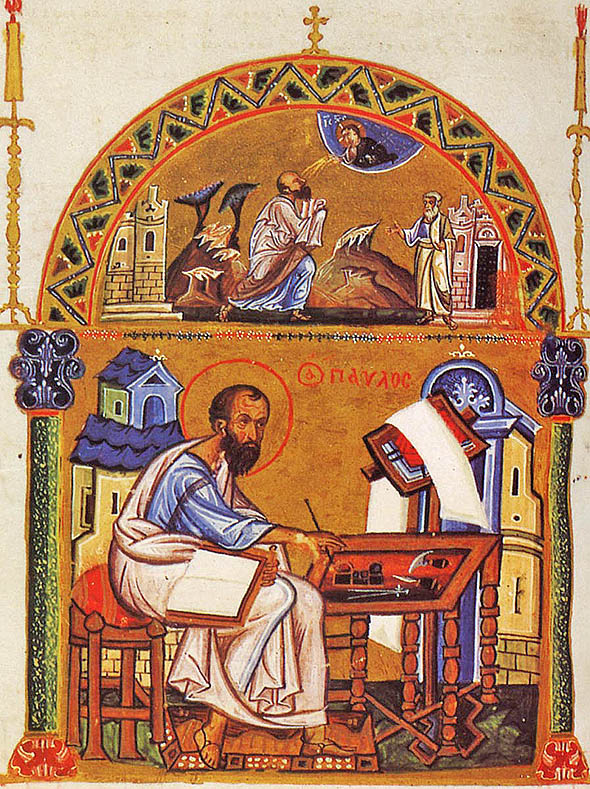
More than all other people, it’s Paul who shows us what we are, how noble our nature is and what measure of virtue we’re able to achieve. And now he arises from the place he has arrived at and, in a clear voice, to all those who condemn our nature, he defends us on the Lord’s behalf, urging us towards virtue, stopping the shameless mouths of those who blaspheme and proving that there’s very little difference between us and the angels, if we but guard ourselves.

Without having a different nature, without receiving a different soul, nor living in another world, but, having been brought up on the same land and place, with the same laws and customs, he surpassed all the people who’ve ever lived since our race was founded. Where are those people who say that virtue’s difficult and evil’s easy? Because Paul rejects this, saying: ‘For this slight, momentary affliction is preparing us for an eternal weight of glory beyond all measure.’ And if such afflictions are slight, how much more so are our pleasures.

The Twelve Apostles: Timid Men who Won the World

An excerpt from a homily by St. John Chrysostom (Hom. 4, 3.4: PG 61, 34-36).

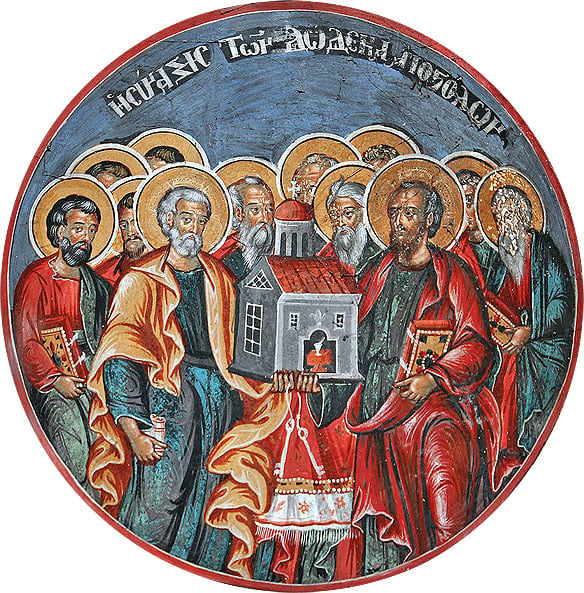
It became clear through unlearned men that the cross was persuasive; in fact, it persuaded the whole world. Their discourse was not of unimportant matters but of God and true religion, of the Gospel way of life and future judgment, and yet it turned ordinary, uneducated men into philosophers. See how the foolishness of God is wiser than people, and his weakness stronger than people!


In what way is it stronger? It made its way throughout the world and overcame everyone; countless people sought to eradicate the very name of Christ, but that name flourished and grew ever mightier. Its enemies lost and perished; the living, who waged a war on a dead man, were shown to be helpless. Therefore, when a Greek tells me I am dead, he shows only that he is really the foolish one, for I, whom he thinks a fool, prove to be wiser than those reputed to be wise. So, also, in calling me weak, he merely shows that he is even weaker. For the good deeds which tax-collectors and fishermen were able to accomplish by God’s grace, are beyond the imagination of philosophers, rulers, and the countless multitudes.

Glorious and All-praised Leaders of the Apostles, Peter and Paul


Sermon of Blessed Augustine, Bishop of Hippo (Ipponesia)

On this present day Holy Church piously remembers the suffering of the Holy Glorious and All-Praiseworthy Apostles Peter and Paul. Saint Peter, the fervent follower of Jesus Christ, for the profound confession of His Divinity: "Thou art the Christ, the Son of the Living God", – was deemed worthy by the Saviour to hear in answer: "Blessed art thou, Simon... I tell thee, that thou art Peter (Petrus), and on this stone (petra) I build My Church" (Mt. 16: 16-18). On "this stone" (petra), is on that which thou sayest: "Thou art the Christ, the Son of the Living God", – it is on this thy confession I build My Church. Wherefore the "thou art Peter": it is from the "stone" (petra) that Peter (Petrus) is, and not from Peter (Petrus) that the "stone" (petra) is – just as how the christian is from Christ, and not Christ from the christian. Do you want to know, from what sort of "rock" (petra) the Apostle Peter (Petrus) was named? – Hear ye the Apostle Paul: "I do not want ye not to know, brethren, – says the Apostle of Christ, – how our fathers were all under a cloud, and all passed through the sea: and all in Moses were baptised in the cloud and in the sea. And all thus eating spiritual food, and all thus drinking spiritual drink: for they did drink from the spiritual accompanying rock: for the rock indeed was Christ" (1 Cor. 10: 1-4). Here is the from whence the "Rock" is Peter.

The Spirit Accomplished the Father’s Will in Men who had Grown Old in Sin

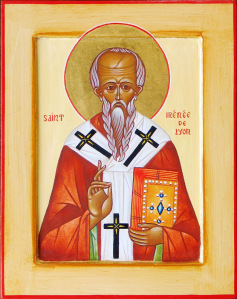
Irenaeus of Lyons:

When the Lord told his disciples to go and teach all nations and baptize them in the name of the Father and of the Son and of the Holy Spirit, he conferred on them the power of giving men new life in God.

He had promised through the prophets that in these last days he would pour out his Spirit on his servants and handmaids, and that they would prophesy.

So when the Son of God became the Son of Man, the Spirit also descended upon him, becoming accustomed in this way to dwelling with the human race, to living in men and to inhabiting God’s creation.

The Spirit accomplished the Father’s will in men who had grown old in sin, and gave them new life in Christ.

When the Holy Spirit of God Enters Into Us the Kingdom of God has Arrived

Nikolai Velimirovich: 

“We have received, not the spirit of the world, but the spirit which is of God” (1 Corinthians 2:12).
Brethren, the spirit of this world is the spirit of pride and cruelty and the Spirit of God is the Spirit of meekness and gentleness.
The apostle of God asserts that the followers of Christ did not receive the spirit of this world rather the Spirit “which is of God,”
i.e., who proceeds from God the Father as a sweet-smelling fragrance as from flowers and as a good fragrance pours out on the soul of man making it mighty, bright, peaceful, thankful and pleasant.
Men by nature are meek and gentle. St. Tertulain writes: “the soul of man by nature is Christian.” But, by the spirit of this world, it is irritable and enraged.

The Descent of the Holy Spirit

Cyril of Jerusalem: 

He came down to clothe the Apostles with power, and to baptize them.


For the Lord says, ye shall be baptized with the Holy Ghost not many days hence (Acts 1:5).


This grace was not in part, but His power was in full perfection.


For as he who plunges into the waters and is baptized is encompassed on all sides by the waters, so were they also baptized completely by the Holy Ghost.

The Mind of Christ and the Advent of the Holy Spirit

Cyril of Alexandria: 

“I have yet many things to say unto you, but ye cannot bear them now.

Howbeit when He, the Spirit of truth, is come, He shall guide you into all the truth:

for He shall not speak from Himself; but what things soever He shall hear, these shall He speak;

and He shall declare unto you the things that are to come” (John 16;12-13).

The new instruction of the Gospel message belongs not to those who are not yet moulded by the Spirit into newness of life and knowledge, and they cannot as yet contain the mysteries of the Holy Trinity.

The Breath of God

John Damascene: 

The Word must also possess Spirit [the Greek term Πνεῦμα denotes both “breath” and “spirit”].

For in fact even our word is not destitute of spirit; but in our case the spirit is something different from our essence.

For there is an attraction and movement of the air which is drawn in and poured forth that the body may be sustained.

And it is this which in the moment of utterance becomes the articulate word, revealing in itself the force of the word.

But in the case of the divine nature, which is simple and uncompound, we must confess in all piety that there exists a Spirit of God, for the Word is not more imperfect than our own word.

In the Fullness of the Spirit of God

Seraphim of Sarov:

Then Father Seraphim took me very firmly by the shoulders and said: “We are both in the Spirit of God now, my son. Why don’t you look at me?”

I replied: “I cannot look, Father, because your eyes are flashing like lightning. Your face has become brighter than the sun, and my eyes ache with pain.”

Father Seraphim said: “Don’t be alarmed, your Godliness! Now you yourself have become as bright as I am. You are now in the fullness of the Spirit of God yourself; otherwise you would not be able to see me as I am.”

Then, bending his head towards me, he whispered softly in my ear: “Thank the Lord God for His unutterable mercy to us!

We Receive the Word and the Spirit in Our Hearts

Symeon the New Theologian: 

Everyone of us believes in him who is the Son of God and son of Mary, ever-virgin and mother of God.

And as believers we faithfully welcome his gospel into our hearts, confessing in words our belief, and repenting with all our soul of our past sins.

Then immediately, just as God the Word of the Father entered the Virgin’s womb, so also in ourselves the word which we receive in learning right belief appears like a seed.

You should be amazed when you hear of such an awe-inspiring mystery, and because the word is reliable you should receive it with full conviction and faith.