Nativiti sermon 2018

Thou hast come, O Lord, into the world and all creation was shaken, the angels gave glory and men worshipped Thy coming and understood the sign of Thine humility, yet mine wretched heart remains hardened and unmoved before Thine ineffable goodness.
Thou hast come as a great light to them that sit in darkness and in the shadow of death, and I remain an abomination standing in Thy holy place.
Thou hast forewarned that Thou hast come into the world to save sinners of whom I am chief, yet I did not comprehend the judgment of Thy justice, O Thou Who art good.
Vouchsafe also unto me the wretched one to glorify Thy Name, O Saviour of the world, and to love Thine appearing in the flesh together with all Thy Saints. Z.

Blind Man

The Lord Jesus was coming from the Temple on the Sabbath, when, while walking in the way, He saw the blind man mentioned in today's Gospel. This man had been born thus from his mother's womb, that is, he had been born without eyes (see Saint John Chrysostom, Homily LVI on Matthew; Saint Irenaeus, Against Heresies, Book V:15; and the second Exorcism of Saint Basil the Great). When the disciples saw this, they asked their Teacher, "Who did sin, this man, or his parents, that he was born blind?" They asked this because when the Lord had healed the paralytic at the Sheep's Pool, He had told him, "Sin no more, lest a worse thing come unto thee" (John 5:14); so they wondered, if sickness was caused by sin, what sin could have been the cause of his being born without eyes. But the Lord answered that this was for the glory of God. Then the God-man spat on the ground and made clay with the spittle. He anointed the eyes of the blind man and said to him, "Go, wash in the Pool of Siloam." Siloam (which means "sent") was a well-known spring in Jerusalem used by the inhabitants for its waters, which flowed to the eastern side of the city and collected in a large pool called "the Pool of Siloam."
Therefore, the Saviour sent the blind man to this pool that he might wash his eyes, which had been anointed with the clay-not that the pool's water had such power, but that the faith and obedience of the one sent might be made manifest, and that the miracle might become more remarkable and known to all, and leave no room for doubt. Thus, the blind man believed in Jesus' words, obeyed His command, went and washed himself, and returned, no longer blind, but having eyes and seeing. This was the greatest miracle that our Lord had yet worked; as the man healed of his blindness himself testified, "Since time began, never was it heard that any man opened the eyes of one that was born blind," although the Lord had already healed the blind eyes of many. Because he now had eyes, some even doubted that he was the same person (John 9:8-9); and it was still lively in their remembrance when Christ came to the tomb of Lazarus, for they said, "Could not this man, who opened the eyes of the blind man, have caused that even this man should not have died?" Saint John Chrysostom gives a thorough and brilliant exposition of our Lord's meeting with the woman of Samaria, the healing of the paralytic, and the miracle of the blind man in his commentaries on the Gospel of Saint John.

Escaping From the Abyss of Sin

  Православие.Ru, 16 мая 2017 г. http://www.pravoslavie.ru/english/103492.htm St. Alexei Mechev Translated by Jesse Dominick  Photo: todayschristianwoman.com Our Lord Jesus Christ tirelessly taught His disciples and those who heard Him. Therefore, huge crowds of people always walked behind Him, thirsting to hear His holy teachings. And now He preaches at the well. He grew tired after a long journey and a sweltering day. The Samaritan Woman came to the well for some water. The Lord began a conversation with her about true prayer and about where we ought to pray to God, and gave her instructions for eternal life, convicting her of secret sins. The Samaritan Woman, hearing this reminder of her intemperate and scampish life with her unlawful husband, was moved thereby to the depths of her conscience and heart—not justifying herself, but from an excess of grateful feelings she exclaimed, Sir, I perceive that thou art a prophet (Jn. 4:19), and led the whole city to meet the Lord. This remarkable woman then became a Christian, receiving the name Photini (“radiant”) in Baptism, later completely justifying the meaning of her name. She preached the name of Christ not just in her homeland, but in other countries—in Africa and in Italy. Together with her younger son she turned many people to Christ. Her older son Viktor served in the army under Nero and was made a commander in Italy, so as to exterminate Christianity there, but instead, as a soldier of Christ, he was the protector of Christians, and like his mother a zealous preacher of the Gospel. When the Roman tyrant learned of it, he ordered the Christians to present themselves to him. At that time, Photini along with her five sisters and her son willingly appeared before the tyrant, and to his question, “Why have you come to us?” they answered, “To teach you to revere Christ.” Then the torturer ordered to crush the hands of the saints on an anvil. However, it crushed neither their faith nor their bodies. It was then ordered to cut off their hands, but the sword was ineffective. The martyrs were imprisoned in a dungeon, but even there they continued to preach Christ, and the place of criminals was turned into a church of God—for which they were subjected to new torments, which eventually ended their suffering lives. St. Photini’s (the Samaritan Woman’s) skin was flayed off, and her body was cast into a well by command of the tyrant. Thus, she who at the well left the path of sin and received from the Life-giver living water and grace, leaving her temporal life behind at the well, passed into another, better, blessed, and eternal life. Such was the Samaritan Woman mentioned in the Gospel. So bravely did she undergo suffering for faith in Christ! Her life is one of the most striking examples of how the grace of God can revive even the most sinful of souls, and raise it up from the chasm of ungodliness to the heights of spiritual glory. Sinful and despised by all, Photini went to the well to secretly draw up some ordinary water, but she drew up “living water, saving water.” This sinner, whom merely to touch was considered defiling by the zealots of the Law, mercifully accepted the Lord and Savior! What great encouragement, what unshakable support for all of us sinners. The Lord is always, every minute ready to accept everyone who turns to Him with sincerity and depth of contrition. Therefore, my friends, no matter how corrupt we are, it is worth it to turn to the Lord Jesus in full repentance; but our turning to the Lord and Savior must not consist merely of empty words, or lamenting for a minute, but of a sincere and firm determination to escape from the abyss of sin, without turning back.

The Nativity of Our MostHoly Lady Mother of God and EverVirgin Mary:

Commemorated on September 8 

The Most Holy Virgin Mary was born at a time, when people had reached such limits of decay of moral values, that it seemed altogether impossible to restore them. The best minds of this era were aware and often said openly, that God must needs come down into the world, so as to restore faith and not tolerate the ruination of the race of mankind. The Son of God chose for the salvation of mankind to take on human nature, and the All-Pure Virgin Mary, – alone worthy to contain in Herself and to incarnate the Source of purity and holiness, – He chose as His Mother. The Birth of Our Most Holy Lady Mother of God and Ever Virgin Mary is celebrated by the Church as a day of universal joy. Within the context of the Old and the New Testaments, on this radiant day was born the MostBlessed Virgin Mary, – having been forechosen through the ages by Divine Providence to bring about the Mystery of the Incarnation of the Word of God, and She is revealed as the Mother of the Saviour of the World, Our Lord Jesus Christ.

HOMILY ON THE BAPTISM OF THE LORD

St. John of Kronstadt

For as many of you as have been baptized into Christ have put on Christ (Gal. 3:27)

Except a man be born again, he cannot see the kingdom of God… Except a man be born of water and of the Spirit, he cannot enter into the kingdom of God (Jn. 3:3, 5)

According to his mercy he saved us, by the washing of regeneration,
and renewing of the Holy Ghost (Titus 3:5).

A new, bright feast has arrived; the day of Light, the day of the most glorious, mysterious Baptism of the Lord, to Whom we are obligated for our renewal or rebirth, enlightenment, restoration, and adoption by the heavenly Father from Whom humankind was estranged for several thousand years by the defilement of sin.

SPIRITUAL INSTRUCTION ON THE FEAST OF THE THEOPHANY

This is my beloved Son, in whom I am well pleased; hear ye him.
Mt 3:17; 17:5

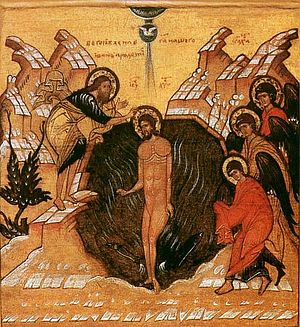
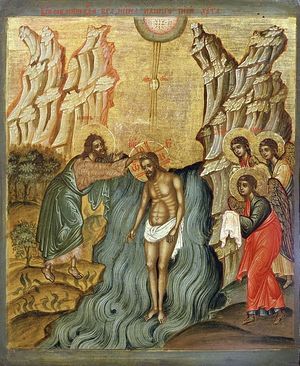
Icon of the Baptism of the Lord.Thus did the voice of the pre-eternal God the Father speak to people about the pre-eternal God the Son, when the Son, at the behest of the Father, through the action of the Spirit, became incarnate of the Virgin and wrought the salvation of perishing mankind. Brothers! Let us show obedience to the Son of God, as God desires of us, that Divine good will might abide with us.

SERMON FOR THE SUNDAY AFTER THEOPHANY

St. Ignatius (Brianchaninov)

Repent for the kingdom of heaven is at hand. (Matt. 4:17)

With these profound and holy words, the incarnate Word began His preaching to fallen mankind. Outwardly, such simple teaching! But one must understand it with his very life: then these short and simple words which are contained in all of the Gospel will be revealed. Just as the holy Apostle Paul, when preaching the Gospel, which he did throughout almost all the known world, said that he testified “both to the Jews, and also to the Greeks, repentance toward God, and faith toward our Lord Jesus Christ” (Acts 20:21).

ON THE BAPTISM OF CHRIST

St. Theophan the Recluse

Celebrating holy Theophany, we are transported in thought to the very place of this event, and we shall intelligently attend to what is happening there! There it is—Bethabara! You can see St. John standing on the shore, in clothes made of camel’s hair, with a girdle of a skin about his loins (Mk. 1:6). He is surrounded by a countless multitude of people from Jerusalem, Judea, and all the lands around the Jordan. The Baptism of the Lord has just finished, and all eyes are fixed upon the Son of man just emerged from the waters. They see nothing else. But sharpen by faith the eye of your mind, and following after John, passing over what is seen by all, turn an attentive gaze upon what is not seen by all—on the opened heavens, the dove descending, and the voice saying, Thou art my beloved Son, in whom I am well pleased (Mk. 1:11). Fix your gaze, and do not tear your attention away from this wondrous vision! O! Who will give power to our words, that they might worthily sing praises to God in three hypostases, revealed at the Jordan!

Assemblage ("Sobor" or Synaxis") of the Forerunner and Baptist of the Lord

Commemorated on January 7

Assemblage ("Sobor" or Synaxis") of the Forerunner and Baptist of the Lord

In the Orthodox Church the custom was established, that on the day following the Great Feasts of the Lord and the Mother of God, would be remembered those saints who most essentially participated in whichever the sacred event. And thus, on the day following after the Theophany of the Lord, the Church honours he that participated directly in the Baptism of Christ, indeed placing his own hand upon the head of the Saviour. Saint John, the holy Forerunner and Baptist of the Lord, termed by our Lord the greatest of the prophets, both concludes the history of the Old Testament and opens up the epoch of the New Testament.