Showing posts with label Entrance of the Theotokos into the Temple. Show all posts

Entry of the Mother of God into the Temple

St. Gregory Palamas

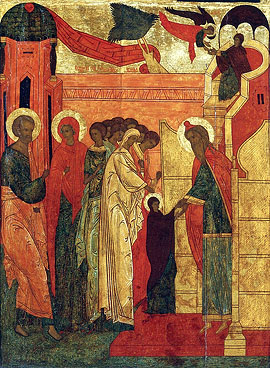
Entry in the Temple. Icon fragment, 16th century.If a tree is known by its fruit, and a good tree bears good fruit (cf. Mt. 7:17; Lk. 6:44), then is not the Mother of Goodness Itself, She who bore the Eternal Beauty, incomparably more excellent than every good, whether in this world or the world above? Therefore, the coeternal and identical Image of goodness, Preeternal, transcending all being, He Who is the preexisting and good Word of the Father, moved by His unutterable love for mankind and compassion for us, put on our image, that He might reclaim for Himself our nature which had been dragged down to uttermost Hades, so as to renew this corrupted nature and raise it to the heights of Heaven. For this purpose, He had to assume a flesh that was both new and ours, that He might refashion us from out of ourselves. Now He finds a Handmaiden perfectly suited to these needs, the supplier of Her own unsullied nature, the Ever-Virgin now hymned by us, and Whose miraculous Entrance into the Temple, into the Holy of Holies, we now celebrate. God predestined Her before the ages for the salvation and reclaiming of our kind. She was chosen, not just from the crowd, but from the ranks of the chosen of all ages, renowned for piety and understanding, and for their God-pleasing words and deeds.

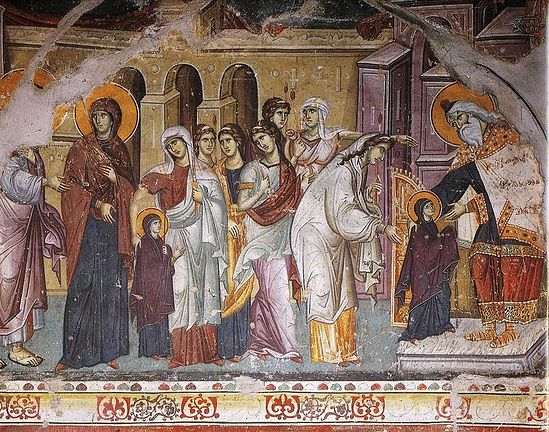
HOMILY ON THE DAY OF THE ENTRY OF THE MOST HOLY THEOTOKOS INTO THE TEMPLE

St. Philaret of Moscow
Hearken, O daughter, and see, and incline thine ear; and forget thine own people and thy father’s house. And the King shall greatly desire thy beauty,1 for He Himself is thy Lord, and thou shalt worship Him.

Ps. XLIV: 9-10

God is wondrous in His ways, for in order to make blessed the being that comes from Him with a most exalted and incomprehensible blessedness, He from the ages deigned to unite His own nature with the nature of man, in the Person of His Only-Begotten Son—thus through Him to extend this union also to the fullness of the Church, which, according to the law of incarnation, is His body, and in this manner dissolving and as if mutually leveling all divinity with all lowly things, That in the dispensation of the fullness of times (Eph. 1:10), as the apostle says, When all things shall be subdued unto him, then shall the Son also himself be subject unto him that put all things under him, that God may be all in all (1 Cor. 15:28). This great resolution of the eternal counsel, or, according to the Apostle, thismystery, although it hath been hid from ages and from generations, is now made manifest also to his saints (Col. 1:26); and the Holy Spirit nevertheless revealed even this very revelation, which bears seven seals,to His mystics, and through them to all humankind to the extent of its gradually growing understanding obligating it to match up to and facilitate its fulfillment. Thus did one of the Prophets, who saw mankind in the past days of its infancy and under the guardianship of the law growing to the fullness of its years, when it was obligated to become capable of its task of being betrothed to Divinity and giving birth to a timeless Child, portrays the Son of God as the King approaching the wedding. And taking upon himself the role of the bringer of the bride, or friend of the bridegroom, the Prophet as if impatiently convinces human nature not to further postpone this blessed union by betrayal and insubordination, but to commit itself to it through sincerity and faithfulness. Hearken, O daughter, and see, and incline thine ear; and forget thine own people and thy father’s house. And the King shall greatly desire thy beauty

The Veneration of the Theotokos According to the Bible

Archimandrite Cleopa (Ilie)

We Orthodox Christians honor the Theotokos Mary more than all the saints and angels of heaven for she was found worthy to give birth to Christ, the Savior of the world by the overshadowing of the Holy Spirit. The honor we render to the Mother of the Lord is exceptional, most honorable and most revered, for she is not only "a friend of His,” as are the other saints, but she is Most Holy (Panagia) above all the saints and all the angels.

For this the angels as much as people venerate and honor her with prayers, hymns, church services and eulogies. Similarly the Archangel Gabriel greeted her at the annunciation (Luke 1:28-29) as well as Saint Elizabeth, the mother of Saint John the Baptist (Luke 1:40-43).

Homily on the Entrance of the Theotokos into the Temple

By St. Gregory Palamas

If a tree is known by its fruit, and a good tree bears good fruit (Mt. 7:17; Lk. 6:44), then is not the Mother of Goodness Itself, She who bore the Eternal Beauty, incomparably more excellent than every good, whether in this world or the world above? Therefore, the coeternal and identical Image of goodness, Preeternal, transcending all being, He Who is the preexisting and good Word of the Father, moved by His unutterable love for mankind and compassion for us, put on our image, that He might reclaim for Himself our nature which had been dragged down to uttermost Hades, so as to renew this corrupted nature and raise it to the heights of Heaven. For this purpose, He had to assume a flesh that was both new and ours, that He might refashion us from out of ourselves. Now He finds a Handmaiden perfectly suited to these needs, the supplier of Her own unsullied nature, the Ever-Virgin now hymned by us, and Whose miraculous Entrance into the Temple, into the Holy of Holies, we now celebrate. God predestined Her before the ages for the salvation and reclaiming of our kind. She was chosen, not just from the crowd, but from the ranks of the chosen of all ages, renowned for piety and understanding, and for their God-pleasing words and deeds.