Showing posts with label Homilies on the Gospel of John. Show all posts

Homily 56, 57, 58, 59. on the Gospel of John

St. John Chrysostom
5. Sunday after Pasha,
Homilies on the Gospel of John, 

John 9:1-2

And as Jesus passed by, He saw a man which was blind from his birth. And His disciples asked Him, saying, Master, who did sin, this man, or his parents, that he was born blind?

INTERPRETATION OR COMMENT ON THE GOSPEL ACCORDING TO JOHN.


S. CYRIL, ARCHBISHOP OF ALEXANDRIA
BOOK V. 7
Chap. ix. And passing by He saw a man blind from his birth.
While the Jews were raging against Him and now essaying to wound Him with stones, forthwith He goes forth of the temple that is among them, and takes Him away from the unholiness of His pursuers. And in passing by, straightway He seeth one blind from his birth, and setteth him as a token and that most clear that He will remove from the abominable behaviour of the Jews, and will leave the multitude of the God-opposers, and will rather visit the Gentiles, and to them transfer the abundance of His Clemency. And He likens them to the blind from his birth by reason of their having been made in error and that they are from their first age as it were bereft of the |684 true knowledge of God, and that they Have not the light from God, i. e., the illumination through the Spirit.

Sixth Sunday of Pascha: Sunday of the Blind Man (John 9:1-38)

by Blessed Theophylact, 
Archbishop of Ochrid and Bulgaria

From the Explanation of the Gospel of St. John,

1–2. And as Jesus passed by, He saw a man who was blind from his birth. And His disciples asked Him, saying, Master, who did sin, this man, or his parents, that he was born blind? 

Homilies on the Gospel of John: Sunday of Samaritan Women

St. John Chrysostom
Homily 31,32,33,34 John 4:5-40

Fifth Sunday of Pascha The Samaritan Woman (John 4: 5-42)

From The Explanation of The Gospel of St. John

by Blessed Theophylact, Archbishop of Ochrid and Bulgaria

On the Sunday of the Samaritan Woman (Jn. 4: 4 - 27)

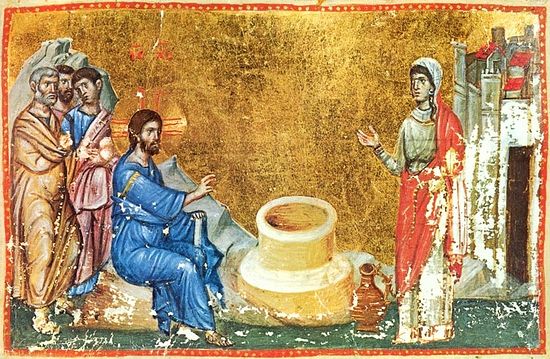
Christ and the Samaritan Woman (Jn. 4: 4 - 27). Miniature from a 13th c. Gospels
Archimandrite John (Krestiankin)


In the name of the Father, and of the Son, and of the Holy Spirit!
Christ is Risen!

Our friends, the feast of Holy Pascha has already reached Mid-Feast and is now approaching its leave-taking. The Church of Christ, our guide to salvation, condescending to the infirmity of our weakened souls, once again calls us to the source of living waters, to the word of God, which alone can quicken our soul, spirit, and body.

Fourth Sunday of Pascha
Healing of the Paralytic

John 5:1-15

From The Explanation of the Gospel of St. John

by Blessed Theophylact, Archbishop of Ochrid and Bulgaria


St. John Chrysostom, 
Homilies on the Gospel of John, 
3. Saturday after Pasha, 
John 15:17-16.2

These things I command you, that you love one another.John 15:17
That is, It is not to upbraid, that I tell you that I lay down My life for you, or that I ran to meet you, but in order to lead you into friendship. Then, since the being persecuted and insulted by the many, was a grievous and intolerable thing, and enough to humble even a lofty soul, therefore, after having said ten thousand things first, Christ entered upon this matter. Having first smoothed their minds, He thus proceeds to these points, showing that these things too were for their exceeding advantage, as He had also shown that the others were. For as He had told them that they ought not to grieve, but rather to rejoice, because I go to the Father, (since He did this not as deserting but as greatly loving them,) so here also He shows that they ought to rejoice, not grieve. And observe how He effects this. He said not, I know that the action is grievous, but bear for My sake, since for My sake also ye suffer, for this reason was not yet sufficient to console them; wherefore letting this pass, He puts forward another. And what is that? It is that this thing would be a sure proof of their former virtue. And, on the contrary, you ought to grieve, not because you are hated now but if you were likely to be loved; for this He implies by saying,

St. John Chrysostom, 
Homily 45, 47. 
on the Gospel of John, 
3. Friday after Pasha, 
John 6:48-54

St. John Chrysostom, 

Homilies on the Gospel of John, 

3. Thursday after Pasha, 

Jn.6.40-44

And this is the will of Him that sent Me, that every one which sees the Son, and believes in Him, may have everlasting life. John 6:40

Is not then this Your will? And how sayest Thou, I have come to send fire upon the earth, and what have I desired to see, if that be already kindled? Luke 12:49 For if Thou also desirest this, it is very clear that Your will and the Father's is one. In another place also He says, For as the Father raises up the dead and quickens them, even so the Son quickens whom He will. John 5:21
St. John Chrysostom, 
Homilies on the Gospel of John, 
6. 35-39

3. Wednesday after Pasha, 

St. John Chrysostom
Homily 44,45 on the Gospel of John
3. Monday after Pasha
John 6:26-33

John 6:26-27
Jesus answered them, and said, Verily, verily, I say unto you, You seek Me, not because ye saw the miracles but because ye did eat of the loaves and were filled. Labor not for the meat which perishes, but for that meat which endures unto everlasting life.

SAINT JOHN THE THEOLOGIAN, APOSTLE AND EVANGELIST

Commemorated May 8/21, June 20/July 3, September 26/October 9


Апостол Иоанн Богослов
The Apostle and Evangelist St. John, called the Theologian, was the son of Salome and Zebedee. Zebedee was a fisherman of Galilee who possessed rather vast holdings with workers. He was a member of some importance in the Jewish community, having access to the high priest. John's mother Salome is mentioned as being one of the ranks of women who served God with their possessions.
John was at first the disciple of St. John the Baptist. Listening to his witness of Christ as the Lamb of God Who takes away the sins of the world, he, together with Andrew the First-Called, followed the Saviour. Being a steadfast disciple of the Lord, he and his brother James were called by the Lord Himself at a later time after a successful catch of fish in the sea of Galilee. Together with Peter and James, John was deigned worthy to become close to the Lord, being with Him during the most important and triumphant times of His earthly life. Thus, he was worthy to be present at the resurrection of the daughter of Jairus, to see Christ's transfiguration on Mount Tabor, to hear the discourse on the signs of His second coming, and to witness to His prayer at Gethsemane. At the Last Supper he was so close to the Lord that in his own words, he lay his head upon Christ's bosom, whence originated his name "bosom-friend," which has since become a name for someone who is especially close.

St. John Chrysostom, 
Homily 39, 40. on the Gospel of John, 
2. Sunday after Pasha
John 5:17-24

The Explanation of the Gospel of  St. John, 
St. John Chrysostom, 
Homily 86, 87 
The Second Sunday of Pascha - Thomas Sunday
Explanation of the Gospel of St. John

by Blessed Theophylact, Archbishop of Ochrid and Bulgaria
The Second Sunday of Pascha -Thomas Sunday


CYRIL,Archbishop of Alexandria,
ON THE GOSPEL ACCORDING TO JOHN.19-31 BOOK XII.
Apostol Tomas Sunday