The Man Born Blind

Metropolitan Anthony of Sourozh

In the Name of the Father, the Son and the Holy Spirit.

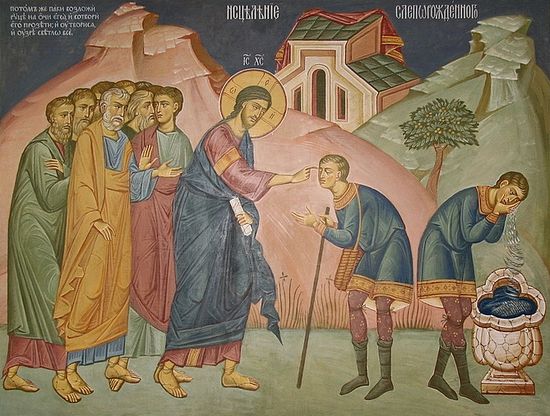
Before his meeting with Christ the blind man had never seen anything. Everything was dark, he had to guess at things, to explore them by touch, to use his imagination. He had no clear authentic image of things. Then he met Christ, and Christ opened his eyes. And what was the first thing this man saw? The face of Christ, His gaze; the face of God become man, the divine gaze full of attentive, compassionate love resting on him, on him alone out of the whole crowd. Straight away he came face to face with the living God and encountered the miracle which so astonishes us: that God can focus His attention on each one of us — as on the lost sheep — and not see the crowd but see the one and only person. After that the man probably surveyed everything around him, and what he had known by description, by hearsay, became reality — "now I see".

Saint Augustine of Hippo on the Sunday of the Blind Man

Tractate 44 on the Gospel of John

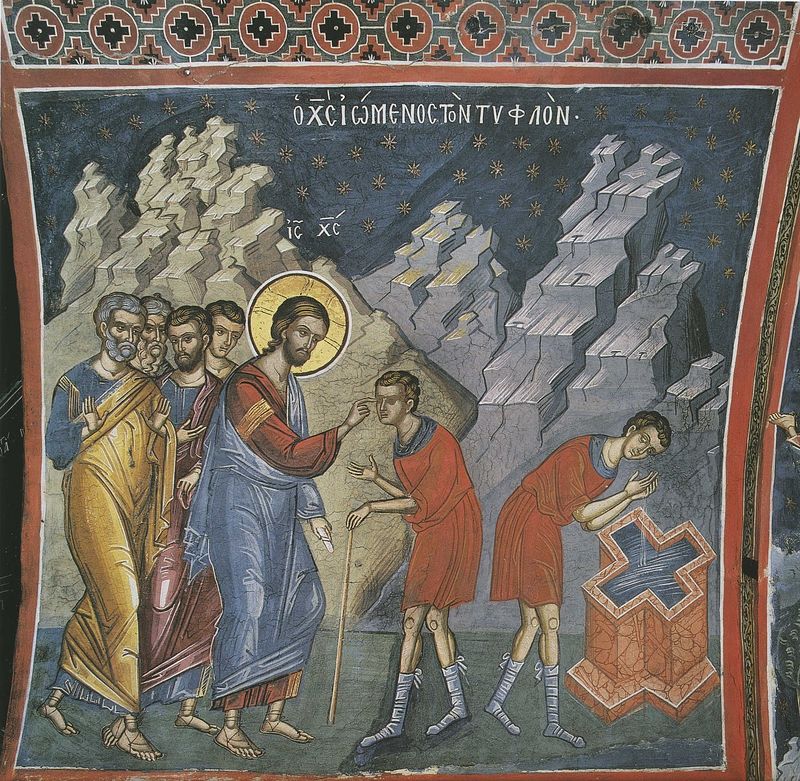
1. We have just read the long lesson of the man born blind, whom the Lord Jesus restored to the light; but were we to attempt handling the whole of it, and considering, according to our ability, each passage in a way proportionate to its worth, the day would be insufficient. Wherefore I ask and warn your Charity not to require any words of ours on those passages whose meaning is manifest; for it would be too protracted to linger at each. I proceed, therefore, to set forth briefly the mystery of this blind man’s enlightenment. All, certainly, that was done by our Lord Jesus Christ, both works and words, are worthy of our astonishment and admiration: His works, because they are facts; His words, because they are signs. If we reflect, then, on what is signified by the deed here done, that blind man is the human race; for this blindness had place in the first man, through sin, from whom we all draw our origin, not only in respect of death, but also of unrighteousness. For if unbelief is blindness, and faith enlightenment, whom did Christ find a believer at His coming? Seeing that the apostle, belonging himself to the family of the prophets, says: And we also in times past were by nature the children of wrath, even as others. Ephesians 2:3 If children of wrath, then children of vengeance, children of punishment, children of hell. For how is it by nature, save that through the first man sinning moral evil rooted itself in us as a nature? If evil has so taken root within us, every man is born mentally blind. For if he sees, he has no need of a guide. If he does need one to guide and enlighten him, then is he blind from his birth.

On Worshipping God in Spirit and in Truth

Homily on the Sunday of the Samaritan Woman. 

 St. Ignatius (Brianchaninov)

Translated by Nun Cornelia (Rees)

The true worshippers shall worship the Father in spirit and in truth:
for the Father seeketh such to worship him.
John 4:23

Beloved brethren! Today we have heard in the Gospel that the true servants of the true God worship Him in Spirit and in Truth, and that God seeks, that is, He desires to have such worshippers. If God desires to have such worshippers, then it is obvious that he will receive only such worshippers and servants, and they only are pleasing to Him. This teaching was imparted to us by the Son of God Himself. We believe in the teaching of Christ! We accept the all-holy teaching of Christ with all our love! In order to follow Him carefully, let us look at what it means to worship God the Father in Spirit and in Truth.

Mid-Pentecost

Ioannis Foundoulis

Most of the faithful don’t know about this feast. Apart from priests and a few other Christians who are more closely involved with the Church, most don’t even know of its existence. Few go to church on the day and most of them don’t even suspect that the Wednesday after the Sunday of the Paralytic is celebrated by the Church as a great feast of the Lord, the Feast of Mid-Pentecost. And yet this feast was once a major feast of the Great Church of Constantinople and crowds of people attended it.

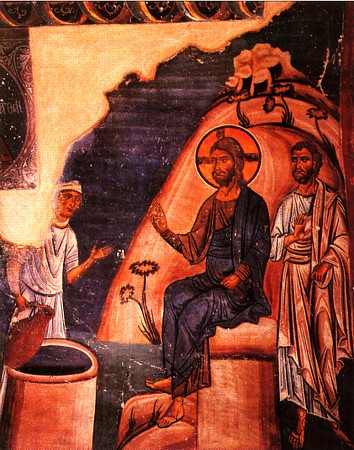
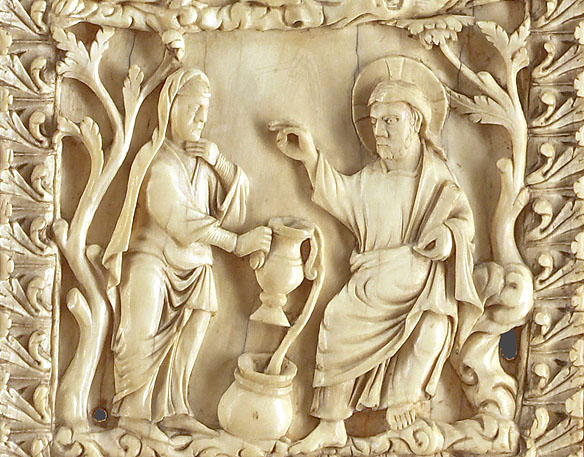
Meeting with the Samaritan Woman

Professor of Theology at the University of Thessaloniki Georgios I. Mantzaridis

Any encounter with Christ astonishes people. If you’re not astonished, you should ask yourself whether you actually encountered Christ, if you really felt His presence. This astonishment isn’t inexplicable, nor absurd, but rather it’s understandable and rational. It’s something that occurs when the natural meets the supernatural, the relative meets the absolute and the transitory meets the eternal.

Sunday of the Paralytic

Archpriest Andrew Phillips

In the Name of the Father and of the Son and of the Holy Spirit.

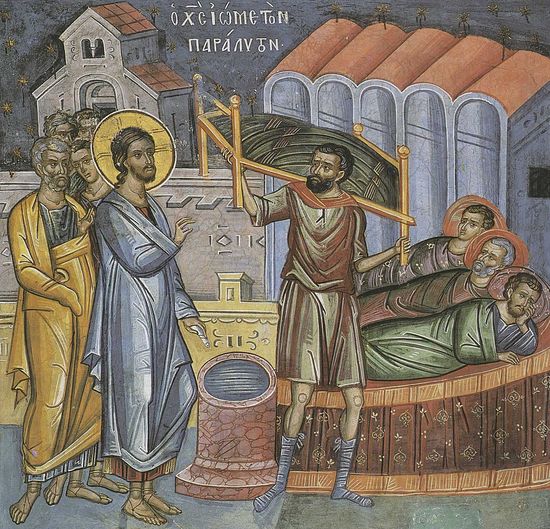
Today's Gospel of the healing of the paralytic raises a number of questions.

The first perhaps is:

Where does illness come from?

The answer to this question is contained within the selfsame Gospel, in the words of Our Lord to the healed paralytic: 'Sin no more lest a worse thing come unto thee'. In other words, the origin of illness is in sin.

How does Christ’s Resurrection take place within us?

Saint Symeon the New Theologian
 Brethren and Fathers, Easter is now here, the festive day that brings us joy and gladness, the day of Christ’s Resurrection, which comes round once a year, or, to put it better, occurs daily and perpetually in those who know its mystery, filling our hearts with joy and inexpressible elation. At the same time, it marks the end of the efforts of the holy fast, or, better, has perfected our souls and has, at the same time, comforted them. So, as you see, it has summoned all the faithful to rest and thanksgiving.

A Paschal Homily

by St. Justin Popovich

Our father, Archimandrite Justin Popovich (1894-1979) was a theologian, a champion, a writer, a critic of the pragmatic church life, a philosopher, and archimandrite of the Monastery Celije, near Valjevo.

Homily on the Descent into Hades

by St Epiphanius of Cyprus

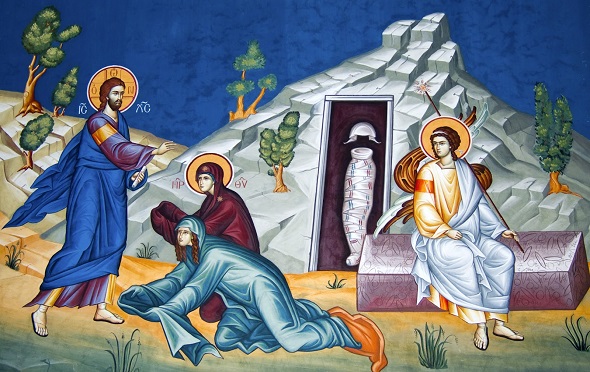
Something strange is happening—there is a great silence on earth today, a great silence and stillness. The whole earth keeps silence because the King is asleep. The earth trembled and is still because God has fallen asleep in the flesh and he has raised up all who have slept ever since the world began.

THE SONG OF SIMEON, THE PRESENTATION OF CHRIST, AND THE GREEK OLD TESTAMENT

Gabe Martini

February 2nd marks the celebration of one of the twelve Great Feasts of the Orthodox Church year: The Presentation (or Meeting) of Christ in the Temple.

This is a feast that recalls the Gospel story of the infant Christ being presented to the elder Simeon in the temple (Luke 2:25-32), a man of great age. The Nunc dimittis or Song of Simeon is a recorded response as this old, frail servant of the Lord beholds the incarnate Lord of Glory for the very first time. In this moment, he knew his life was complete; he had fulfilled his purpose.