

Showing posts with label 5. Sunday after Pasha. Show all posts
Showing posts with label 5. Sunday after Pasha. Show all posts
The Man Born Blind
In the Name of the Father, the Son and the Holy Spirit.
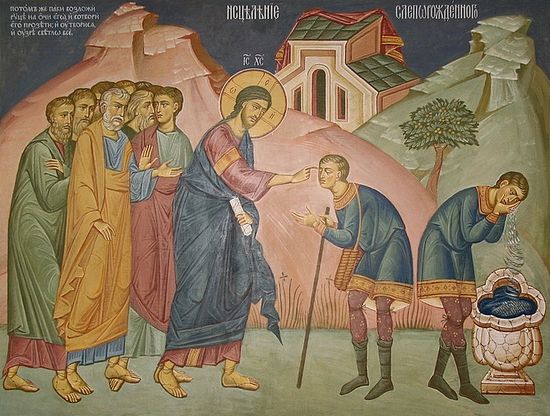
Before his meeting with Christ the blind man had never seen anything. Everything was dark, he had to guess at things, to explore them by touch, to use his imagination. He had no clear authentic image of things. Then he met Christ, and Christ opened his eyes. And what was the first thing this man saw? The face of Christ, His gaze; the face of God become man, the divine gaze full of attentive, compassionate love resting on him, on him alone out of the whole crowd. Straight away he came face to face with the living God and encountered the miracle which so astonishes us: that God can focus His attention on each one of us — as on the lost sheep — and not see the crowd but see the one and only person. After that the man probably surveyed everything around him, and what he had known by description, by hearsay, became reality — "now I see".

Saint Augustine of Hippo on the Sunday of the Blind Man
Tractate 44 on the Gospel of John
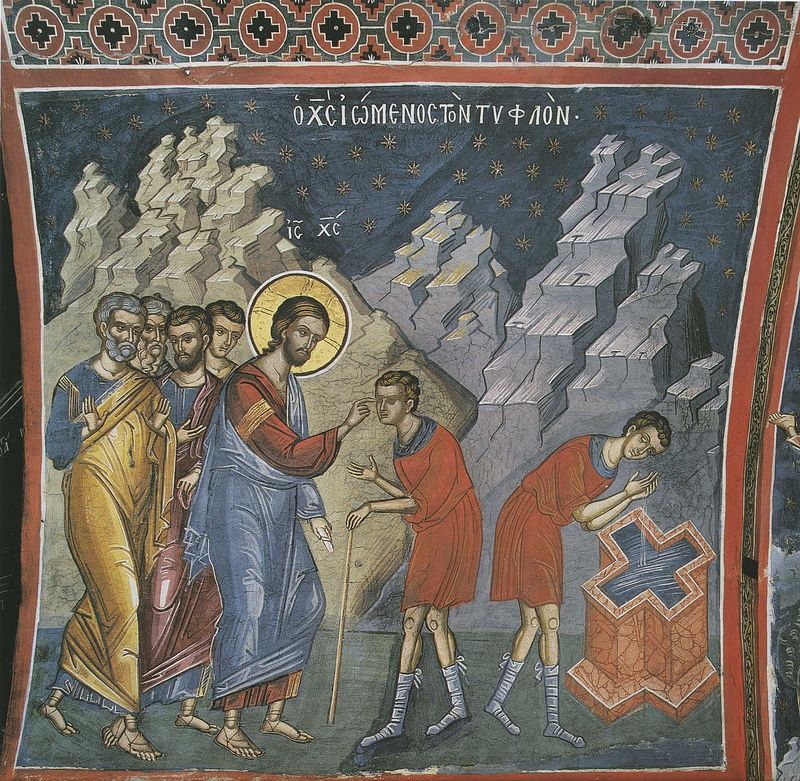
1. We have just read the long lesson of the man born blind, whom the Lord Jesus restored to the light; but were we to attempt handling the whole of it, and considering, according to our ability, each passage in a way proportionate to its worth, the day would be insufficient. Wherefore I ask and warn your Charity not to require any words of ours on those passages whose meaning is manifest; for it would be too protracted to linger at each. I proceed, therefore, to set forth briefly the mystery of this blind man’s enlightenment. All, certainly, that was done by our Lord Jesus Christ, both works and words, are worthy of our astonishment and admiration: His works, because they are facts; His words, because they are signs. If we reflect, then, on what is signified by the deed here done, that blind man is the human race; for this blindness had place in the first man, through sin, from whom we all draw our origin, not only in respect of death, but also of unrighteousness. For if unbelief is blindness, and faith enlightenment, whom did Christ find a believer at His coming? Seeing that the apostle, belonging himself to the family of the prophets, says: And we also in times past were by nature the children of wrath, even as others. Ephesians 2:3 If children of wrath, then children of vengeance, children of punishment, children of hell. For how is it by nature, save that through the first man sinning moral evil rooted itself in us as a nature? If evil has so taken root within us, every man is born mentally blind. For if he sees, he has no need of a guide. If he does need one to guide and enlighten him, then is he blind from his birth.
Sixth Sunday After Pascha: Sunday Of The Blind Man

Introduction
The sixth Sunday after the Feast of Holy Pascha is observed by the Orthodox Church as the Sunday of the Blind Man. The day commemorates the miracle of Christ healing the man who was blind since birth. The biblical story of this event is found in the Gospel of Saint John 9:1-41.
Homily 56, 57, 58, 59. on the Gospel of John

St. John Chrysostom
5. Sunday after Pasha,
Homilies on the Gospel of John,
John 9:1-2
And as Jesus passed by, He
saw a man which was blind from his birth. And His disciples asked Him, saying,
Master, who did sin, this man, or his parents, that he was born blind?
INTERPRETATION OR COMMENT ON THE GOSPEL ACCORDING TO JOHN.

S. CYRIL, ARCHBISHOP OF ALEXANDRIA
BOOK V. 7
Chap. ix. And passing by He saw a man blind from his birth.
While the Jews were raging against Him and now essaying to wound Him with stones, forthwith He goes forth of the temple that is among them, and takes Him away from the unholiness of His pursuers. And in passing by, straightway He seeth one blind from his birth, and setteth him as a token and that most clear that He will remove from the abominable behaviour of the Jews, and will leave the multitude of the God-opposers, and will rather visit the Gentiles, and to them transfer the abundance of His Clemency. And He likens them to the blind from his birth by reason of their having been made in error and that they are from their first age as it were bereft of the |684 true knowledge of God, and that they Have not the light from God, i. e., the illumination through the Spirit.
The Spiritual Blindness of Sin

By St. Tikhon of Zadonsk
Whatever physical darkness is for the eyes, so is sin for the human soul. The spiritual darkness so darkens and blinds the eyes of the soul, that the sinner walks like the blind: he doesn't know where the path leads him; he doesn't see before him the torment of an eternal death in which he might fall; he doesn't distinguish vice from virtue, evil from good, truth from lies, true good fortune from evil fortune, and, thus, seeing he does not see and acts by touching like the blind.
Does he live in good fortune? He becomes violent, as an untrained and unrestrained horse, and does not see that with this good fortune God draws him to Himself as a father of a little child draws an apple. Will misfortune visit him? He grumbles, is indignant and blames, that as if he told a lie; he makes complaints and says a malicious word: "Am I a liar? In what have I sinned? Am I really more sinful than others? Am I worthy of this? Does my work deserve this?" He justifies himself, being full of every kind of untruth; he cleanses himself, being all besmirched; he considers himself unworthy of temporal punishment, but worthy of the eternal; he praises his merits, which stand for nothing.
Synaxarion For the Sunday of the Blind Man

By Nikephoros Kallistos Xanthopoulos
SUNDAY of THE Blind Man
On this day, the sixth Sunday of Pascha, we commemorate the miracle wrought by our Lord, God, and Savior Jesus Christ upon the man who was blind from his birth.
Verses
O Bestower of light, Who art Light coming forth from Light,Thou givest eyes to the man blind from birth, O Word.
Sixth Sunday of Pascha: Sunday of the Blind Man (John 9:1-38)
 by Blessed Theophylact,
 Archbishop of Ochrid and Bulgaria
From the Explanation of the Gospel of St. John,
1–2. And as Jesus passed by, He saw a man who was blind from his birth. And His disciples asked Him, saying, Master, who did sin, this man, or his parents, that he was born blind?
Excerpt from St. John Chrysostom on the healing of the Blind Man

Christ is risen! Truly He is risen!
Excerpt from St. John Chrysostom's homily: "On zeal and piety, and on the man born blind" (amateur translation)
The word of God is a spring of light. The light therefore fills, and the light shines, and illumines the senses of the faithful. For from Him and in Him shines, and those who partake of Him shine. And He does not only enlighten the minds of the faithful, but grants the name of light. For the divine Scripture, for those who dwell with the ignorant and who live in disbelief, rightly calls them darkness, not receiving the lamp of truth, that they might be sons of light. Therefore, the divine Apostle Paul writes: "We were not sons of the night, nor of the darkness, but sons of the light and day." And regarding the sons of light was the evangelical word spoken from the mouth of God: "I am," as Christ said, "the light of the world. He who follows me will not walk in darkness, but will have the light of life."
On the Sunday of the Man Born Blind
Archpriest Andrew Phillips
In the Name of the Father and of the Son and of the Holy Spirit.
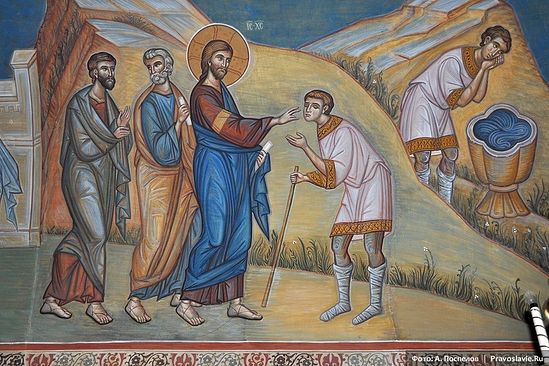
On this Sunday, that before the Feast of the Ascension of Christ, the Church recalls to our attention the Gospel of the man born blind. There are two points here that I would particularly like to remark on.
Sermon on the Sunday of the Blind Man

Archimandrite Tikhon (Shevkunov)
Christ is Risen!
Perhaps today’s story of the healing of the blind man is especially important for us, for our generation. When the Savior walked near the blind man—who was known throughout Jerusalem—but did not ask him anything, not even about his faith, he passed by him and healed him. The blind man became a man who sees. The Pharisees began interrogating him, asking him who worked this great good for him—something they themselves would never have been able to do.
Subscribe to:
Posts (Atom)