THE NATIVITY SERMON OF ST. JOHN CHRYSOSTOM

Icon of the Nativity of Christ.
 St. John Chrysostom

BEHOLD a new and wondrous mystery

My ears resound to the Shepherd’s song, piping no soft melody, but chanting full forth a heavenly hymn. The Angels sing. The Archangels blend their voice in harmony. The Cherubim hymn their joyful praise. The Seraphim exalt His glory. All join to praise this holy feast, beholding the Godhead here on earth, and man in heaven. He Who is above, now for our redemption dwells here below; and he that was lowly is by divine mercy raised.

Bethlehem this day resembles heaven; hearing from the stars the singing of angelic voices; and in place of the sun, enfolds within itself on every side, the Sun of justice. And ask not how: for where God wills, the order of nature yields. For He willed; He had the power; He descended; He redeemed; all things yielded in obedience to God. This day He Who is, is Born; and He Who is, becomes what He was not. For when He was God, He became man; yet not departing from the Godhead that is His. Nor yet by any loss of divinity became He man, nor through increase became He God from man; but being the Word He became flesh, His nature, because of impassability, remaining unchanged.

The Table is Laden: A Homily on the Sunday of the Holy Forefathers

Jesse Dominick

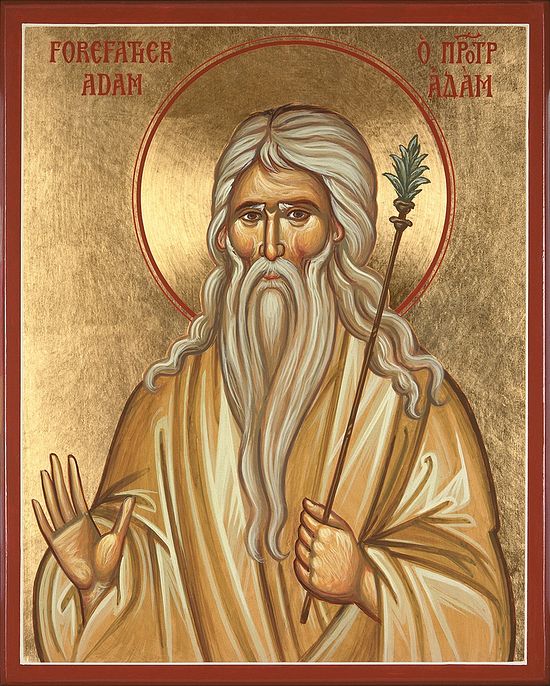
Holy Forefather Adam 

A certain man made a great supper, and bade many. Brothers and sisters, in today’s Gospel we heard about a great feast that has been prepared. A servant is sent out to call the invited, but they make many excuses for why they cannot come to the feast. Angered, the man sends his servant out to invite the poor, and the blind, and the maimed, and all those who are destitute, and they joyfully accept the invitation to the great feast. The man who has prepared the feast is God the Father, and His servant is our Lord Jesus Christ. The table is laden, we have only to lay aside our excuses and accept the invitation.

Entry of the Mother of God into the Temple

St. Gregory Palamas

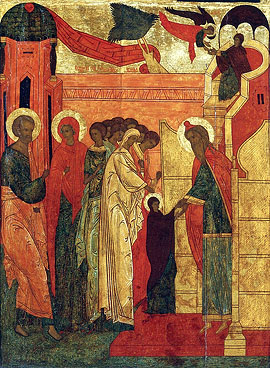
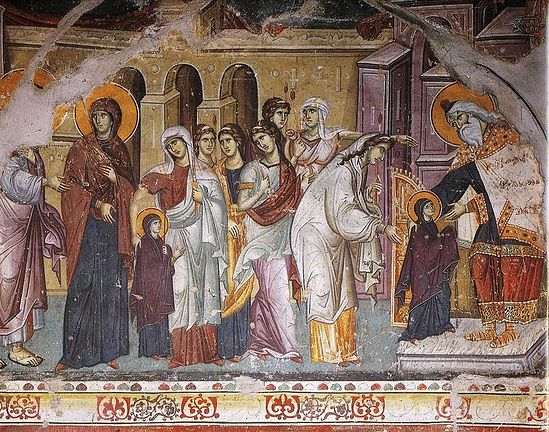
Entry in the Temple. Icon fragment, 16th century.If a tree is known by its fruit, and a good tree bears good fruit (cf. Mt. 7:17; Lk. 6:44), then is not the Mother of Goodness Itself, She who bore the Eternal Beauty, incomparably more excellent than every good, whether in this world or the world above? Therefore, the coeternal and identical Image of goodness, Preeternal, transcending all being, He Who is the preexisting and good Word of the Father, moved by His unutterable love for mankind and compassion for us, put on our image, that He might reclaim for Himself our nature which had been dragged down to uttermost Hades, so as to renew this corrupted nature and raise it to the heights of Heaven. For this purpose, He had to assume a flesh that was both new and ours, that He might refashion us from out of ourselves. Now He finds a Handmaiden perfectly suited to these needs, the supplier of Her own unsullied nature, the Ever-Virgin now hymned by us, and Whose miraculous Entrance into the Temple, into the Holy of Holies, we now celebrate. God predestined Her before the ages for the salvation and reclaiming of our kind. She was chosen, not just from the crowd, but from the ranks of the chosen of all ages, renowned for piety and understanding, and for their God-pleasing words and deeds.

HOMILY ON THE DAY OF THE ENTRY OF THE MOST HOLY THEOTOKOS INTO THE TEMPLE

St. Philaret of Moscow
Hearken, O daughter, and see, and incline thine ear; and forget thine own people and thy father’s house. And the King shall greatly desire thy beauty,1 for He Himself is thy Lord, and thou shalt worship Him.

Ps. XLIV: 9-10

God is wondrous in His ways, for in order to make blessed the being that comes from Him with a most exalted and incomprehensible blessedness, He from the ages deigned to unite His own nature with the nature of man, in the Person of His Only-Begotten Son—thus through Him to extend this union also to the fullness of the Church, which, according to the law of incarnation, is His body, and in this manner dissolving and as if mutually leveling all divinity with all lowly things, That in the dispensation of the fullness of times (Eph. 1:10), as the apostle says, When all things shall be subdued unto him, then shall the Son also himself be subject unto him that put all things under him, that God may be all in all (1 Cor. 15:28). This great resolution of the eternal counsel, or, according to the Apostle, thismystery, although it hath been hid from ages and from generations, is now made manifest also to his saints (Col. 1:26); and the Holy Spirit nevertheless revealed even this very revelation, which bears seven seals,to His mystics, and through them to all humankind to the extent of its gradually growing understanding obligating it to match up to and facilitate its fulfillment. Thus did one of the Prophets, who saw mankind in the past days of its infancy and under the guardianship of the law growing to the fullness of its years, when it was obligated to become capable of its task of being betrothed to Divinity and giving birth to a timeless Child, portrays the Son of God as the King approaching the wedding. And taking upon himself the role of the bringer of the bride, or friend of the bridegroom, the Prophet as if impatiently convinces human nature not to further postpone this blessed union by betrayal and insubordination, but to commit itself to it through sincerity and faithfulness. Hearken, O daughter, and see, and incline thine ear; and forget thine own people and thy father’s house. And the King shall greatly desire thy beauty

The Veneration of the Theotokos According to the Bible

Archimandrite Cleopa (Ilie)

We Orthodox Christians honor the Theotokos Mary more than all the saints and angels of heaven for she was found worthy to give birth to Christ, the Savior of the world by the overshadowing of the Holy Spirit. The honor we render to the Mother of the Lord is exceptional, most honorable and most revered, for she is not only "a friend of His,” as are the other saints, but she is Most Holy (Panagia) above all the saints and all the angels.

For this the angels as much as people venerate and honor her with prayers, hymns, church services and eulogies. Similarly the Archangel Gabriel greeted her at the annunciation (Luke 1:28-29) as well as Saint Elizabeth, the mother of Saint John the Baptist (Luke 1:40-43).

ON LUKE 9:37-43. HEALING OF THE DEMON-POSSESSED BOY

St. Cyril of Alexandria

But it came to pass, the day after, as they came down from the mountain, a great crowd met Him. And, behold, a man cried out from the crowd, saying, Teacher, I beseech Thee to regard my Son, for he is my only one. And lo, a spirit taketh him, and he suddenly crieth out, and it convulseth and teareth him, and he foameth; and having bruised him scarcely departeth from him. And I besought Thy disciples to cast him out, and they could not. And Jesus answered, and said: O faithless and perverse generation, how long shall I be with you, and suffer you? Bring thy son hither. And when he was yet coming, the devil threw him down, and convulsed him. But Jesus rebuked the unclean spirit, and healed the child, and gave him to his father. And all wondered at the majesty of God.

JESUS RAISES THE SON OF THE WIDOW OF NAIN

(Sunday sermon of October 9, 2011)

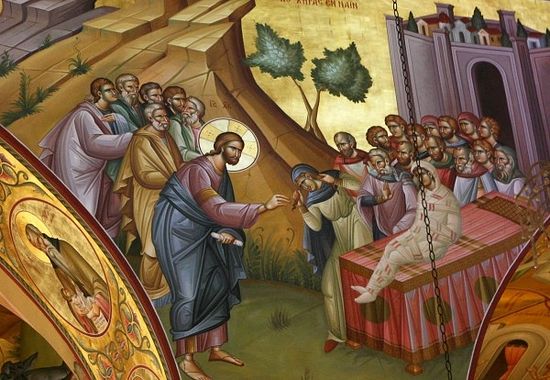
Raising of the Son of the Widow of Nain. 

"And when He came near the gate of the city, behold, a dead man was being carried out, the only son of his mother; and she was a widow. And a large crowd from the city was with her. When the Lord saw her He had compassion on her and said to her, "Do not weep" (vs.12-13).

These few words, "Do not weep", encompass the whole purpose of Christ's coming to the world. Today's moving gospel reading from Luke 7:11-17 reminds us that Jesus came to wipe away our tears, to soften our pain, and to lighten the burden of life. One can only imagine how painful must have been the grief of the widow on her way to the cemetery to bury her only child - a son. St.Luke tells us that a "large crowd from the city was with her", but no matter how many people around her, she was now alone and aware only of her pain and grief. In the beautiful city of Nain in the region of Galilee, all she could see was two graves - that of her husband and now that of her only son. Now we might hastily think that this is simply the tragic story of one woman. But isn't it really everyone's story? Life can be beautiful for a while, but inevitably the day comes when it is no longer so. There is suffering; there is trouble; there is war; there is death. The result of all this is grief - an utterly painful experience that all of us must at some point in life come to terms with.

THE WIDOW OF NAIN

Twenty-first Sunday after Pentecost


In the Name of the Father and of the Son and of the Holy Spirit.

Today's Gospel concerns the resurrection of the son of the widow of Nain. We recall that this miracle occurred just after the healing of the servant of the centurion, a healing which had taken place at a distance.

We can notice how this miracle of resurrection, like all the Lord's miracles, happened for two reasons.

The Protection (Pokrov) of the MostHoly Mother of God

Commemorated on October 1

The Protection (Pokrov) of the MostHoly Mother of God: "The Virgin today doth stand forth within the Church, and with the choirs of the Saints invisibly for us doth pray to God: angels with hierarchs make reverence, and apostles with prophets sing forth: for us the Birthgiver of God prayeth the Praeternal God" – this miraculous appearance of the Mother of God occurred in the mid-X Century at Constantinople, in the Blakhernae church where there was preserved the Robe of the Mother of God, Her Head-Veil (mathoria) and part of the Belt-Sash, transferred from Palestine in the V Century. On Sunday, 1 October, during the time of the all-night vigil, when the church was overflowing with those at prayer, the Fool-for-Christ Saint Andrew (Comm. 2 October) at the fourth hour of the night lifted up his eyes towards the heavens, and beheld coming through the air our MostHoly Lady Mother of God resplendent with an Heavenly light and surrounded by an assembly of the Saints. The holy Baptist of the Lord John and the holy Apostle John the Theologian accompanied the Queen of Heaven. On bended knee the MostHoly Virgin began with tears to pray for Christians and for a long time was at prayer. Then, coming nigh the Prestol'-Throne, She continued Her prayer, which having completed She then took from Her head the veil and spread it over the people praying in church, protecting them from enemies both visible and invisible. The MostHoly Lady Mother of God was resplendent with Heavenly glory, and the protecting veil in Her hands gleamed "more than the rays of the sun". Saint Andrew gazed atrembling at the miraculous vision and he asked of his disciple Blessed Epiphanios standing alongside him: "Dost thou see, brother, the Queen and Lady, praying for all the world?" Epiphanios answered: "I do see, holy father, and I be in awe". The Ever-Blessed Mother of God implored of the Lord Jesus Christ to accept the prayers of all the people, calling on His MostHoly Name and hastening in recourse to Her intercession. "O Heavenly King, – sayeth in prayer the Immaculate Queen standing aethereally amidst the Angels, – accept every person, that prayeth unto Thee and calleth on My Name for help, let them not go empty away unheard from before My Visage". Saints Andrew and Epiphanios, granted to behold the Mother of God at prayer, "for a long time did gaze at the protecting veil spread over the people and the lightning like flashes in glory to the Lord; as long as the MostHoly Mother of God was there, so likewise was the protecting veil visible; but with Her departure it likewise became invisible, and though having taken it with Her, She left behind the grace of having been there". At the Blakhernae church was preserved the memory of the miraculous appearance of the Mother of God. In the XIV Century, the Russian pilgrim and clerk Aleksandr saw within the church an icon of the MostHoly Mother of God praying for the world, and written such, as depicting Saint Andrew in contemplation of Her. But the Greek Church does not know this feast. [trans. note: i.e. does not historically celebrate this feast. Our Russian source is here reticent concerning the historical circumstances occasioning the necessary protective intercession of the Mother of God, and it reflects a great irony, that for the Russians rather than for the Greeks this should be an important feast, since it celebrates the Divine destruction by a storm of a large pagan-Russian fleet under Askold and Dir which threatened Constantinople itself, sometime in the years 864-867, or per the Russian historian Vasiliev on 18 June 860. The Russian Primary Chronicle of Saint Nestor notes this miraculous deliverance following the all-night vigil and the dipping of the garment of the Mother of God into the waters of the sea at the Blakhernae church, but without mention of Saints Andrew and Epiphanios and their vision of the Mother of God at prayer. These latter elements, and the beginnings of the celebrating of the feast of Pokrov, seem to postdate Saint Nestor and the Chronicle. A further historical complication might be noted under the 2 October entry for Saint Andrew – that of his demise in the year 936. Either this year of death might not be quite reliable, or that he survived into quite extreme old age after the vision of his youth, or that his vision involved some historically later pagan-Russian raid which met with the same fate. The below suggestion likewise that the Saint Andrew of the vision was a Slav (or a Skyth per other sources, such as S. V. Bulgakov) – is a nice touch, but not necessarily chauvinism: the extent of historical South Slavic penetration and re-population into Greece is the stuff of scholarly disputes]. In the Prologue, a Russian book of the XII Century, is contained a description about the establishing of the special feastday in honour of this event: "For lo, when we heard, – we realised, how wondorus and merciful was the vision and moreover an expectation and intercession on our behalf, without celebration... and it transpired, that Thy holy Pokrov-Protection should not remain without festal-celebration, O Ever-Blessed One!". Wherefore in the festal celebration of the Divine-services to the Pokrov-Protection of the Mother of God, the Russian Church intones: " With the choirs of the Angels, O Sovereign Lady, with the venerable and glorious prophets, with the First-Ranked Apostles and with the PriestMartyrs and Sainted-hierarchs pray Thou for us sinners, glorifying the feast of Thine Protection in the Russian Land". And moreover, it would seem that Saint Andrew, contemplating the miraculous vision, was a Slav, taken captive and at Constantinople given over into slavery to the local inhabitant named Theognost. Churches in honour of the Pokrov-Protection of the Mother of God appeared in Russia in the XII Century. Widely known on its architectural merit is the temple of the Pokrov at Nerla, which was built in the year 1165 by holy Prince Andrei Bogoliubsky. Through the efforts of this holy prince was also established in the Russian Church the feast itself, the Pokrov-Protection of the Mother of God, in about the year 1164. At Novgorod in the XII Century there existed a monastery of the Pokrov of the MostHoly Mother of God (the so-called Zverinsk monastery); at Moscow also under tsar Ivan the Terrible was built the cathedral of the Pokrov of the Mother of God at the church of the Holy Trinity (known as the church of Saint Basil the Great). On the feast of the Pokrov-Protection of the MostHoly Mother of God we implore the defense and assist of the Queen of Heaven: "Remember us in Thine prayers, O Lady Virgin Mother of God, that we perish not by the increase of our sins, protect us from every evil and from grievous woes; for on Thee do we hope, and venerating the feast of Thine Pokrov, Thee do we magnify". © 1996-2001 by translator Fr. S. Janos.

Fr. Dumitru Staniloae

October 5 marks the anniversary of the repose of the renowned Romanian theologian Fr. Dumitru Staniloae. His many works include commentaries on the Church Father, a Romanian translation of the Philokalia, and his 1978 masterpiece The Orthodox Dogmatic Theology. Fr. Dumitru endured several years of imprisonment for his faith at the hands of Communists, after which he began to work for the Romanian Holy Synod and often traveled to international conferences to share his theological vision. He reposed in 1993 at the age of ninety.

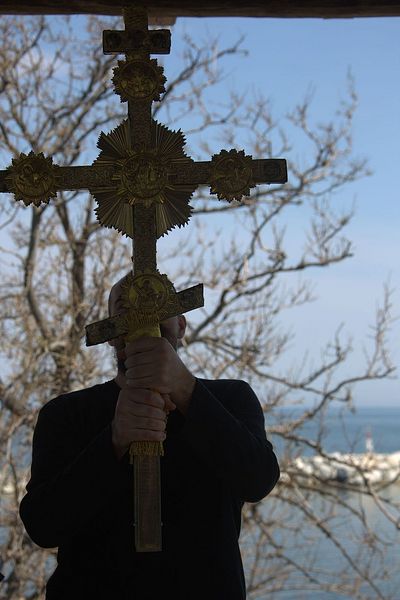
Below we offer his work on "The Cross as a Means of Sanctification and Transformation of the World" in honor of his memory: