Showing posts with label 2. Sunday after Pasha. Show all posts

On the Path of Faith (Thomas’ Sunday)

Metropolitan Meletios of Nikopolis

1. How we react

Every time we have any feast in our Church, we celebrate the mystery of our salvation.

The purpose of the feast is to glorify God for His boundless mercy, His goodness and His interest in us.

We see this love of His from a different point of view at every feast. But all the feasts are aimed at opening our minds and hearts so that we can understand the great mystery of veneration and of our salvation.

Today the event which we’re celebrating and observing is something that makes us people really angry and annoyed. Why?

Third Sunday After Pascha: 
Feast Of The Holy Myrrhbearers

Introduction
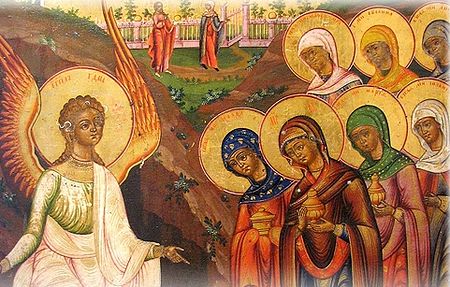
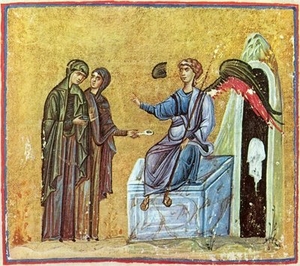
The third Sunday after the Feast of Holy Pascha is observed by the Orthodox Church as the Sunday of the Holy Myrrhbearers. The day commemorates when the women disciples of our Lord came to the tomb to anoint his body with myrrh-oils but found the tomb empty. As the woman wondered what this meant, angels appeared proclaiming that Christ had risen from the dead.

Sunday of the Myrrh-Bearing Women

Archbishop Savva (Raevsky)

Christ is Risen!
Dear Brothers and Sisters in the Lord! 

Today is dedicated to the Holy Myrrh-Bearing Women. This is a great feast day for everyone, but especially for women, Christian women, who like the Myrrh-Bearers sacrifice their time and labor and resources, that is, all they have, for the good of the Church and their neighbor.

The Fidelity and Love of the Myrrh-Bearing Women
Metropolitan Philaret of Eastern American and New York 

Today the Holy Orthodox Church, as you know, glorifies the Holy Myrrh-Bearing Women, for which reason this Sunday is called the “Sunday of the Myrrh-Bearing Women.”

Yesterday we already spoke of how the Myrrh-Bearing Women were, in essence, the first heralds of Christ’s Resurrection and, in a certain sense, as one Russian holy hierarch put it, the Apostles to the Apostles themselves.

St. John Chrysostom
Homily 14 on the Acts of the Apostles
Acts VI. 1-7


Blessed Theophylact, Archbishop of Ochrid and Bulgaria
Second Sunday after Pentecost
Come Follow Me
Matthew 4:18-23


All-Conquering Love 
Bishop Alexander (Mileant)


And when the Sabbath was past, Mary Magdalane, and Mary the mother of James, and Salome,
had brought sweet spices, that they might come and anoint Him.
And very early in the morning the first day of the week, they came unto the sepulcher at the rising of the sun.

The Diligence and Love of the Myrrhbearing Women

The diligence of the Holy Myrrhbearing Women is truly great and their fervent love for the Lord is constant. Free from every earthly predilection their hearts lived and breathed only for the Lord: all their thoughts, desires and hope were concentrated in Him and all their blessings and treasure consisted in Him. For the sake of their beloved Teacher they willingly leave their homes, their close and known relatives, forget the weakness of their gender, are not frightened by the cruelty of the numerous enemies of the Lord, steadily follow Him everywhere, long-sufferingly pass through the cities and villages with Him and minister to Him from their means. They do not abandon their beloved Teacher during His suffering and His death.
The Myrrhbearing Women and the Christian Women of Today
By Elder Sofian (Boaghiu)
 

As you know, the third Sunday after Easter is the Sunday of the Myrrhbearing women, or the Sunday of the faithful and the housewives who maintain the Christian family in this world. You should be happy that you partake of this special attention from our Resurrected Lord. And behold, because through our most pure Mother Theotokos and the Holy Myrrh-bearing women, you have a Sunday a year, when you are especially honored. May the Lord multiply in you the grace and gifts of the Holy Spirit and may the gift of Christian love abide truly with you, in order to be what you are called, maintainers of Christian’  warmth and harmony in your family. For many families today are met with disaster… as you know better than me, so I will not speak about it.

Sunday of the Samaritan Woman

Liturgical  Services
The Holy Myrrhbearers and Contemporary Christian Women

by S. V. Bulgakov

The diligence of the Holy Myrrhbearing Women is truly great and their fervent love for the Lord is constant. Free from every earthly predilection their hearts lived and breathed only for the Lord: all their thoughts, desires and hope were concentrated in Him and all their blessings and treasure consisted in Him. For the sake of their beloved Teacher they willingly leave their homes, their close and known relatives, forget the weakness of their gender, are not frightened by the cruelty of the numerous enemies of the Lord, steadily follow Him everywhere, long-sufferingly pass through the cities and villages with Him and minister to Him from their means.

Akathist to the Lifebearing Tomb of Christ


Kontakion 1
To the chosen Champion Leader risen from the dead, a hymn of victory do we sing unto Thee, O Christ Eternal King, for Thou hast risen from the tomb: and we being delivered from everlasting corruption, bring joyous acclamations unto Thine honorable tomb crying out:
Rejoice, life-bearing tomb whence Christ hath risen!

Synaxarion For the Sunday of the Myrrhbearers


By Nikephoros Kallistos Xanthopoulos

SUNDAY of THE MYRRH-BEARERS

On this day, the third Sunday of Pascha, we celebrate the Feast of the Holy Myrrh-Bearing women; and we also commemorate Joseph of Arimathæa, who was a secret disciple, and also Nicodemos, who was a disciple by night.

Verses

The women disciples bring myrrh unto Christ.
And I bring a hymn as it were myrrh unto them?

Homily For the Sunday of The Myrrhbearing Women
by Saint Gregory Palamas

The resurrection of the Lord is the regeneration of human nature. It is the resuscitation and re-creation of the first Adam, whom sin led to death, and who because of death, again was made to retrace his steps on the earth from which he was made. The resurrection is the return to immortal life. Whereas no one saw that first man when he was created and given life—because no man existed yet at that time—woman was the first person to see him after he had received the breath of life by divine inbreathing. For after him, Eve was the first human being. Likewise no one saw the second Adam, who is the Lord, rise from the dead, for none of his followers were near by and the soldiers guarding the tomb were so shaken that they were like dead men. Following the resurrection, however, it was a woman who saw Him first before the others, as we have heard from Saint Mark’s Gospel today. "After his resurrection Jesus appeared on the morning of the Lord’s Day [Sunday] to Mary Magdalene first."
Saint Theophylact of Ochrid

Third Sunday of Pascha
The Myrrh-bearing Women
Mark 15:43-16:6

St. John Chrysostom 
Homily 43,44 on the Gospel of John 
John 6:16-27

St. John Chrysostom

Homily 13 on the Acts of the Apostles
Acts 5:19-33

Imprisonment and Release
     Then having risen up, the high-priest and they that were with him (which is the sect of the Sadducees) were filled with indignation, and laid their hands on the Apostles, and put them in the common prison.
     Having risen up, that is, being roused, being excited at the things taking place, the high-priest and they which were with him (which is the sect of the Sadducees) were filled with indignation, and laid their hands on the Apostles: they now assault them more vigorously: and put them in the common prison; but did not immediately bring them to trial, because they expected them again to be softened down. But the Angel of the Lord opened the prison doors, and brought them forth, and said, Go, stand and speak in the temple to the people all the words of this life. And when they heard that, they entered into the temple early in the morning, and taught. Acts 5:19-21

St. John Chrysostom
Homily 12 on the Acts of the Apostles

Acts 5. 1-132
And Joses, who by the Apostles was surnamed Barnabas (which is, being interpreted, The son of consolation), a Levite, and of the country of Cyprus, having land, sold it, and brought the money, and laid it at the Apostles' feet.

St. John Chrysostom, 
Homily 39, 40. on the Gospel of John, 
2. Sunday after Pasha
John 5:17-24
St. John Chrysostom, 
Homilies on the Acts of the Apostles, 

4. 13-22
Peter and John Threatened, Released